Friday, July 29, 2022

Beware of investing in bonds during rising interest rates environment?

Bond yields have increased significantly the past few months as central banks all over the world are raising interest rates. Banks are now offering fixed deposit rates at more than 2% again and another attractive investment which people see are bonds where the yield has increased significantly. The SGS bonds, which are issued by the Singapore government has yields of close to 3% for its 2, 5, 10, 20 and 30 years bond. This is 3x more than then average of 1% just 1 year ago. 

Looking at the chart below of a 5 and 10 year SGS bond, we can see that the yield has increased significantly from 2020 to now which corresponds to the increase in interest rates around the world. Is this a good time to invest into bonds now? 
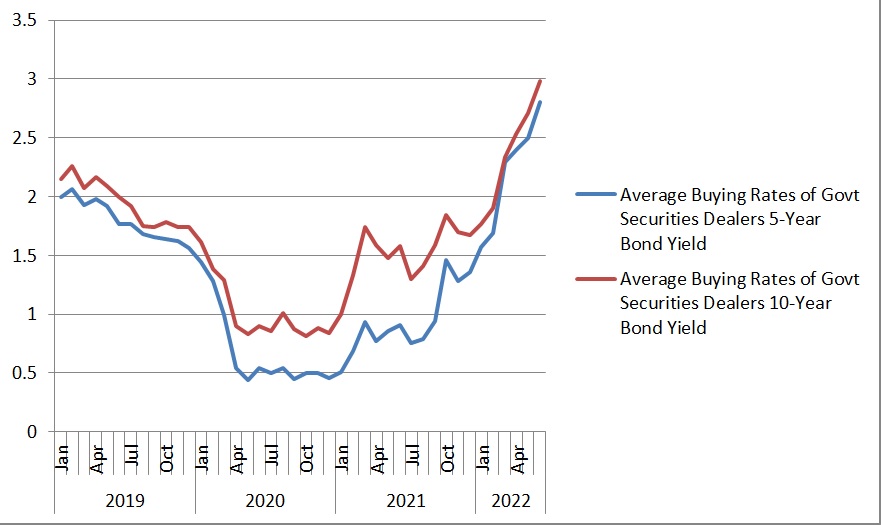
5 and 10 year SGS Bond Yield 2019-2022

Unfortunately, bonds can be the worse to invest during rising interest rates environment. When you invest into a bond, the yield (coupon) you get is fixed. For example if you invest in a bond with yield of 3% now, this 3% will be given to you regardless if interest rates continue to increase later. The most scary thing is when interest rates continue to increase later, bond prices will drop where you will see a loss in your investment portfolio. When bond yield increases, bond prices will drop as it is inversely correlated. This is evident as seen in the chart below where interest rates rose from 2020 to 2022 while bond prices started to drop from 2020 onwards. 

5 and 10 year SGS bond price 2019-2022

If you're planning to sell your bond in the short term, it wouldn't be advisable to invest in bonds now as the US is expected to increase interest rates even more for the rest of this year as what the Fed has announced recently. The Fed just raised another 75 basis points on 28 Jul 22 and has announced that another unusually large hike may come in September 22. This will cause bond yield to go up even more and bond prices to come down significantly. 

If you're planning to hold the bond for long term and are buying 5, 10, 20 or 30 years bonds, then it may be a good choice as you get to lock in higher interest rates now and by the time you redeem the bond more than 5 years later, bond prices may have even risen significantly due to interest rates are low again 5 years later. That being said, nobody will be able to predict how long interest rates will stay high or when interest rates will come down. 

Bond prices are trading at below 100 now which is lower than its face value and may represent an opportunity for the long term. Once interest rates stabilise and start to fall again, bond prices will go back up to 100 or even above 100 and at that time, investors who bought the bond below its face value will continue to enjoy the locked in high interest rate plus the capital gains from the bond price increase. This is if you're buying a long term bond and willing to hold on to the bond till its value goes back to par. 

Rising interest rates present quite a lot of opportunities for savers who have cash on hand to invest in high yielding safe assets. If we know how to take advantage of the opportunities which is presented to us, we will end up better in life in the future. 

Enjoyed my articles? 

or follow me on my Facebook page and get notified about new posts.

Thursday, July 14, 2022

Is a Recession Coming?

Just as we thought all is well after COVID and economies around the world start to recover, we are hearing the word recession now. Is this really happening just as we went thorough 2 years of COVID where recession just happened?

Recession just happened during COVID where jobs were lost which led to unemployment going up. Singapore's GDP growth rate became negative in the period of March to June 2020. We would remember that many people lost their jobs, salaries were cut and it was a painful period. Fast forward 2 years later, we are seeing another phenomenon. Inflation went up a lot due to supply chain shocks caused by the Russian Ukraine war. In fact, US inflation rose to 9.1% in June 2022 which is the highest increase in 40 years since the 1980s. 

Inflation is a tricky situation to deal with. With prices increasing, wages need to keep up if not in the long run, the people in the country will suffer with real wage growth stagnating. Real wage growth is the increase in wages minus inflation growth. If the increase in wages is 3% and inflation is also 3%, then real wage growth is 0%. In essence, our wage did not go up at all considering inflation is the same increase. This is true because if our wages don't keep up with inflation, we will feel the impact of the rising cost of living and will be unhappy. 

As workers expect higher wage growth, companies will feel the cost pressure as they also increase the salary of their workers to keep up with market competition. You can see that in Singapore, the public service is leading by example by adjusting salaries to keep up with inflation. Private companies will also start to adjust their salaries so that they can attract and retain talents. As companies face the cost pressure of workers salaries increase, they will adjust the price of their goods and this in turn will affect consumers in the form of higher prices of goods we buy or consume. Coupled with increased prices all over the world due to the Ukraine war etc, we have a situation of huge inflation growth we see now and may even go higher in the next couple of months. 

Now, governments all over the world know this is not sustainable so they will come in and use their monetary policy tools to stabilise the situation. Most countries have an interest rate policy where they increase interest rates to combat high inflation. By increasing interest rates, it becomes harder for individuals and companies to borrow and thus reduce consumption and demand as a whole. This slows down growth and if not done properly, will trigger a recession event where companies start to retrench staff. We have seen this happening in many prominent companies such as Shopee, Tesla and even Google is slowing hiring. Many tech companies such as Shopee rely on investors funds and debt to fund their operations as they are primarily loss making and in expansion mode. With interest rates so high, it doesn't make sense to borrow so much now and thus they are slowing down their operations and keeping cost low. 

We might see a recession coming and jobs might be loss again. If interest rates keep rising and shows no sign of slowing down, we might be hit even harder as borrowers default on their loans if they are unable to pay the higher amount of installment due to higher interest rates. Good news is for the general public who do not have too much loans, we should see prices coming down thereafter. Let's see how the situation evolves as we live in unprecedented times now. 


Monday, May 16, 2022

How Will Our Lives Be Impacted In The Face Of Rising Interest Rates

There has been lots of new stuff happening since my last blog post back in December 2021. A few months back, Singapore started opening up and relaxing measures for COVID-19. It seems life is mostly back to normal now. While we were just starting to enjoy this good news after 2 years of abnormal life during covid, new things start unfolding which is starting to impact our lives and may impact us even further. 

Firstly, the Ukraine-Russian war started. This caused oil prices to skyrocket impacting petrol prices immediately. If you own a car, the impact is felt with petrol prices at more than $3 a litre. Ukraine is one of the largest exporter of many items such as wheat and seed oil like sunflower oil. This impacted daily living also as what we are beginning to experience. Edible oil prices have increased which even cause hawkers to have no choice but to increase their prices for the food they sell. I personally have experienced food prices increasing by 70 cents to $1 for every plate of food. Groceries items in the supermarket have increased as well. Indonesia also recently banned all exports of palm oil which skyrocketed the global palm oil price. Palm oil is used for food manufacturing and it is in close to 50% of the packaged products we find in supermarkets, everything from pizza, doughnuts and chocolate, to deodorant, shampoo, toothpaste and lipstick. We should see prices continue to increase in the months ahead. 

Secondly, because of the risk of high inflation due to higher prices, central banks all around the world are increasing their interest rates to slow down inflation. This is to prevent prices from going too high and making the economy unstable and at risk of a recession. Singapore do not have an interest rate policy so we are a taker of interest rate and will be affected by this by a great extent. Already, we are seeing interest rates for mortgage loans going up from as low as 1% 1 to 2 years ago to 1.3%-1.5% now for floating rate. For fixed rates, it has increased even more to 1.80% for a 5 years fixed rate from DBS. This shows that banks are forecasting that interest rates will continue to increase so they are not keen to price fixed rates loans at low rates anymore. 

Interest rates increase will affect not just home loans but everything in life. The sky high property prices will definitely fall as loans become more expensive and less affordable. Businesses will incur more cost on their loans because of high interest rates so they may pass on the increase cost to consumers. In rising interest rate environment, essentially those who have debt are losers while savers will benefit. We should see higher interest rates for bank accounts soon. You might have noticed that banks are starting to launch higher interest fixed deposit accounts and Singapore Savings Bond is also at an all time high of average 2.53% for a 10 year period. The 1st year interest given for SSB for the May launch is 1.43%, 2nd year will go up to 2.41%, 3rd year at 2.68% and 4th year onwards will be 2.71%. This is the highest SSB rate I've seen in a long time. 

Lastly, with risk free rates like fixed deposit accounts and SSB giving such high interest, investments such as in stocks and Reits become less attractive. You can get 2.5% risk free on SSB while Reits yields about 5% so the difference is only 2.5% but Reits have higher risk so naturally Reits prices start to fall as well. For growth stocks, it also drops as the risk is even higher and with higher interest rates, these businesses which rely on loans to expand their business will face some cost pressures and may slow down their expansion plans which caused their stock prices to drop even more. Nevertheless, stock prices will drop to a certain extend only and its the best time now to pick up some good companies as the stock prices drop. We should see Reits prices coming down and investors will pick them up again when they start to yield more than 6% which better justify the risk to return. 

Those who have bonds in their portfolio (not SSB) will see bond prices coming down as interest rates increase. So, if your portfolio has both bonds and stocks, you will likely see your portfolio drop even further as both bonds and stock prices drop in correlation to rising interest rates. It is still an unknown how much more interest rates will increase so we have to wait and see. 

If you have mortgage loans on 3m SIBOR, the rate as of 9 May has already increased to 1.11% as compared to 0.43% in Jan this year. This is already a 0.7% increase in just 5 months. If your loan is on the new SORA benchmark, interest rate has increased from 0.14% in Jan 22 to 0.89% as of 13 May 22. A 25 years tenure, 500K loan, with 1% rise in interest rates will increase your monthly mortgage payable by $235/month. If its a 1 million loan, it doubles. 

Don't belittle the things that are happening around the world now. All of us will be affected one way of another. We should relook at our financials and adjust accordingly so that we will not end up in deep trouble later. 

Enjoyed my articles? 

or follow me on my Facebook page and get notified about new posts.