Showing posts with label Money Management. Show all posts

Wednesday, August 7, 2019

Early Retirement Through Finding Work That You Enjoy Doing

How many times have you heard people complaining about their work? I'm sure almost on a daily basis be it your family members, your friends, your colleagues and maybe even your boss complains about work to you.

This is why early retirement and financial freedom is so popular. In Singapore, we probably need about $1 Million to retire comfortably. But the bad news is its extremely hard to save this amount of money in a very short time.

In my previous post, I introduced the 30 years retirement grid:


In this grid, it shows how much we need to save and invest to achieve whichever amount we desire for retirement. I figured out we need to save consistently $1500 every month and invest at 4% return for 30 years to achieve $1 Million. 30 years is honestly too long a time if you hate your job every single day. This is 10,950 days of your life!

You can read more about the 30 years retirement grid here.

Introducing the 10 years early retirement grid

In this case, can we achieve retirement in 10 years instead just to get out of the rat race? Let me introduce you the 10 years early retirement grid.


Sadly, you would realise that it is extremely difficult to achieve a desired sum of money for retirement in 10 years even if we invest at 8% return. We need to save $6000 per month to get $1 Million dollars, which will definitely lead to a poor quality of life (unless your income is extremely high). For most of us, even saving 100% of our salary will not lead us to retirement in 10 years.


Introducing the sustainable way to early retirement

The truth is, we don't need to save till we drop to achieve early retirement. Most of us think of retirement as quitting our jobs completely. This shouldn't be the case for early retirement as I can guarantee you that you'll be too bored in a short while.

A financial blogger, Zack from four pillar freedom, who's based in the US, recently quit his job and achieved early retirement before his 30s. Now, he focus his time on his blog which generates a decent $3K plus per month. He mentioned work feels like play for him now which is early retirement to him.

While in SG it may be different for us, I'm sure we can also find something we like to do and still create some sustainable income. It is never an easy journey as income outside of work also takes time to build. The key is doing what we like to do.

Building income outside of work requires times and effort. We need to create value to generate sustainable income. Some ways to create sustainable income outside of work are:
  • Start an online blog writing content which you like
  • Investing in good dividend stocks
  • Providing consultancy services on your expertise areas
  • Providing professional services such as playing musical instruments, singing or doing emcee for events
  • Start a part time business
  • Providing freelance service such as website programming, content writing, design etc
You can see in our world today, there are endless opportunities to create income outside of work. Everyone can do it. 

If creating income outside of work is too tough, we can also find work which is more meaningful and let us feel more fulfilled. Since we are spending so much time at work, it is quite important that we do not work in a job we hate. While we can't totally like our jobs and there will always be conflict, we can at least find some work which we like a bit more. Its just like relationships where there will always be conflicts but we resolve it and get stronger.

Rethinking retirement

If we create income outside of work which we enjoy doing and the income can sustain our monthly expenses, then we have achieved early retirement.

If we work in a job we enjoy and feel fulfilled then perhaps thinking of quitting work totally for retirement is not so critical anymore. If we have enough money, we can even consider slowing down by taking on part time or freelance roles instead of totally quitting.

The end goal is that we feel more fulfilled in life and able to spend time on the things that matter to us more. If you're stressed up having to plan for retirement, perhaps its time to rethink how each of us see retirement in life. Perhaps its time to lead a more purposeful life, creating value and doing more meaningful work in our lives.

Enjoyed my articles? 

or follow me on my Facebook page and get notified about new posts.

Monday, July 29, 2019

The 30 Years Retirement Grid - Saving $1500 per month to achieve $1 Million

I was on course last week and during the course, there were several people who were in their 60s and some even nearing 70s. They were here to upgrade their skills in order to make sure they could still afford to work in their old age. I really admire their attitude to continue learning and still go through the stress of having to sit through an exam to get certified. Many of them were worried they couldn't pass the test and were so stressed out. I thought to myself at this old age they should be enjoying life why still go through this? I spoke to some of them and found out that most had to keep working and in order to get higher salary, they decided to upgrade themselves.

Most of them have been working for more than 30 years but still do not have enough for retirement. Many of them were earning as low as $200 per month back when they first started working. As inflation sets in and things become more expensive in Singapore, it became impossible to retire for them. Some of them even tell me to prepare a house overseas as retirement in Singapore will become even more impossible in the future. Is this really the case?

Is saving $500 per month for 30 years enough for retirement? 

I did some quick calculations and indeed its quite hard for low wage workers to save enough for retirement. If they had diligently saved $500 per month for 30 years, they would only accumulate a savings of $180,000. As we now know, this amount is too little to last for any retirement. For this amount to last 20 years, they can only spend $750 per month.

So, saving $500 per month is definitely not enough for retirement especially during our times now. Then, how much savings is enough?

The 30 Years retirement grid - Saving $1500 per month to achieve $1 Million

For retirement planning, we should first determine how much we need to accumulate? For simplicity sake, let's put this figure at $1 Million since this is the sweet spot to have a good retirement. I did a retirement grid which shows how much our savings and investment will become in 30 years.


Let me guide you on how to read the grid above. The left most column is the savings per month and the top row is the annual investment return. The first figure of $180,000 is derived from saving $500 per month for 30 years with 0% investment return. If there is 1% investment return compounded over 30 years, the sum will be $208,709 instead.

I concluded we need to save at least $1,500 per month for 30 years to get a comfortable retirement sum of $1.01 Million. However, saving $1500 per month is not enough. We still have to invest it at 4% compounded returns to achieve that sum. Without investment, we will only accumulate $540,000. Most of us will start working probably in our mid 20s and in 30 years, we will be about 55 to 60 years old so 30 years timeline is just nice for retirement planning.

If we're not comfortable with 4% investment return, then saving $2000 per month may be a better option as we can accumulate $1.14 Million with just a 3% investment return. If we're still not comfortable with 3% investment return, we can save $2500 per month to accumulate $1.04 Million with just 1% investment return. 1% can be achieved easily through bank interest.


Why income is so important for retirement planning?

If you look closely at the retirement grid I created, you may have notice that savings form a big part of the retirement. If we just save $1000 per month and invest at 6% investment return, we will not even accumulate $1 Million in 30 years.

This is why income is so important for retirement planning. If we earn a low income, it is really quite difficult to save more money. It becomes a very miserable life to save money with too low an income. However, do take note that most of us do start with lower income so the starting point is always more of a sacrifice but it gets easier later.

Investing is also an important part in retirement planning. Looking at savings of $1500 per month in 30 years, a person who does not invest will only accumulate $540K while a person who invests at 4% investment return accumulates $1.01 Million. This is almost double in 30 years! This also shows investing early in our life is quite important.


Retirement planning is time critical

Another thing about retirement is that it is really time critical. The above retirement grid is in a 30 years time frame so it is more manageable. If we are late in the planning stage and only have 20 years till retirement, it will be much more difficult to accumulate substantial savings for retirement.

Here's the 20 years retirement grid:


Let's look at the same $1500 per month savings at 4% investment return. This time, we could only accumulate $536K in 20 years vs $1.01 Million in 30 years. You can see how much difference 10 years is in retirement planning.

Let's say we only start saving and investing in our 40s and look to retirement in our 60s, we have to save double ($3000 per month) as compared to the person who started saving in his 30s ($1500 per month) to achieve the same retirement savings.


Start saving and investing early for retirement!

In conclusion, the earlier we start saving and investing, the better it is. Most people could not see the actual benefits of starting early so many people only realise its too late when they are much older. I hope this retirement grid will finally give you the visualisation to see the benefits of saving and investing early.

The earlier we start, it gets easier as we earn more income. This is because we only have to maintain that same $1500 per month savings instead of saving much more to accumulate that same amount if we start 10 years later.

If you're in your late 20s already, its probably good to start saving that $1500 or $2000 per month from now so that you can retire in your late 50s.

Enjoyed my articles? 

or follow me on my Facebook page and get notified about new posts.

Wednesday, June 27, 2018

Relieve Your Financial Burden With This Strategy

Financial planning is always advocated but little has been said about how to really relieve financial burdens in life. What we are mostly taught is to go to school, get a good job, save money and then plan for retirement. This is not wrong and in fact it is a very important first step in financial planning but what's next?

Today, I will attempt to discover a new way of financial planning which will definitely relieve your financial burdens in life. In fact, you'll realise that this is the way which the government in Singapore has been managing its finances to create a financially sustainable Eco system as Singapore has little to no natural resources to begin with. If we can imitate this and manage our personal or family finances in the same way, the money we have can perhaps last many generations to come.


Discovering how the Singapore Government manages its finances

There is a lot of wisdom to how the Singapore government manages it finances. They do not just create income and then spend it. This is definitely not a financially sustainable way to manage money. How they manage money is to create funds and use the interest generated from the funds to cover some of the expenses which are needed. This can range from social assistance to healthcare and also the net investment return contribution (NIRC) which was talked and discussed quite substantially during the budget earlier this year. There is a lot we can learn from this method which I will elaborate later. Let's dive deeper into the government's way of managing money so we can learn from it.

The following is a paragraph from the Ministry's of Finance website which gives a good overview of how the government creates a sustainable budget from its reserves. I quote it as follows:
How do Singaporeans benefit from the investment returns from our reserves? 
The investment returns from our reserves provide additional resources for Government spending to benefit Singaporeans. This includes Government investments in education, healthcare, transport infrastructure, R&D and other areas to improve our living environment and to grow our economy. 
The ability to tap our reserves in a sustainable manner is a significant financial advantage for Singapore. Our situation is quite unlike that in many countries that have to service their debts and other liabilities from their budgets on an annual basis, and hence either raise taxes for the purpose or engage in further borrowings so as to service current borrowings. 
In Singapore, the Government is instead able to take in money from the investment returns of our reserves to supplement our Budget on a sustained basis, in keeping with the provisions in the Constitution. The few other countries where Governments are able to derive net investment income for public spending are typically those with substantial reserves of natural resources such as oil. 
The investment returns of our reserves supplement the annual Budget through the Net Investment Returns Contribution (NIRC). The NIRC is estimated to be S$14.1 billion in Financial Year (FY) 2017, or 17% of our budget.
There are a lot of debates to the NIRC which I will not go into in this article. What we can see from how the money is managed is that the government has saved up quite substantially over the past few years and have quite a big reserve to invest and generate investment returns to pay for various expenses which we have. This is probably one of the reason why we still can have one of the lowest tax among major economies around the world.

An example on what investment returns are used to pay for is the social assistance schemes under the Ministry of Social and Family (MSF). To date, MSF has a community care endowment fund of $1.9 Billion and able to generate $57.5 Million in interest to pay for various community care programmes to help the low income and those who need it too.

Here is an excerpt from MSF's ComCare Annual Report FY2016:


As we can see, the interest income generated from the fund is used to fund the various social programmes to help the needy in Singapore.


How we can create a fund to relieve our financial burdens?

We can also definitely set aside a fund and generate interest income to pay for some of the expenses in our life. Currently, what is being advocated in the financial planning world is just to put aside your money to invest for retirement. Most of the products out there only just lock up our money for many many years before we can use it for retirement. Some people end up surrendering their policies early because they could not pay the premiums anymore.

The creating your fund strategy is different. It allows us to have some relief of the financial burdens while still prepares us for retirement. In other words, it means we can enjoy now then later. Here are the funds we can set aside and an indication of how much interest we can get on a monthly basis to offset our expenses:


Fund AmountInterest %Monthly Interest Income generated
$200,000 6%$1,000
$300,000 6%$1,500
$400,000 6%$2,000
$500,000 6%$2,500
$600,000 6%$3,000
$700,000 6%$3,500
$800,000 6%$4,000
$900,000 6%$4,500
$1,000,000 6%$5,000

At a 6% interest, $300,000 set aside can already yield us $1,500 per month. I suppose this can offset some of the basic expenses which we have. If you have a family, most likely a fund of $500,000 generating 6% interest will be quite comfortable as it brings you $2,500 per month.

The key is to set aside this amount of money early in life which I would think is not difficult with a good income and modest expenditure. You can take a reference to the above table and plan how much to set aside accordingly to your needs.

You might have questions on how to generate this 6% interest? It is actually not hard to find investments that can yield dividends. The key is to pick the right ones which will be sustainable. REITs and some blue chips stocks can be considered. Take for example Capitaland Mall Trust which currently yields about 5.5% at a price of $2.03 or Suntec REIT which yields 5.89% at a price of $1.70. Of course, we still have to research and analyse whether the dividends will be stable in the long term and whether we are buying at a good valuation. This is like buying a property and making sure we buy at a good price and looking at its rental potential to generate rental income. Blue chip stocks such as Singtel is also yielding about 5.50% currently at a price of $3.19.

Maybe you would think 6% is too hard to achieve. How about if we bring it down to 5%? Let's take a look at the table again:


Fund AmountInterest %Monthly Interest Income generated
$200,000 5%$833
$300,000 5%$1,250
$400,000 5%$1,667
$500,000 5%$2,083
$600,000 5%$2,500
$700,000 5%$2,917
$800,000 5%$3,333
$900,000 5%$3,750
$1,000,000 5%$4,167

At 5%, a $500,000 fund will still generate an income of $2,083 per month. This is still not a bad amount to have as it would definitely relieve some of the expenses which we have. The beauty of this strategy is the fund amount is left untouched and may even increase as the investment grows. At the same time, it provides an income to offset some expenses while we are still working. In this way, if we are prudent in our expenses, we can still continue to save more of our full time job income without having to sacrifice the quality of life.

If you have a partner and both of you are working, you can actually set aside this fund much easier than those who are single. It is really about delayed gratification in the first few years to build up the fund and then it'll be much easier in the future. If we spend all our earned income without putting aside anything, then we will find ourselves still struggling in life as we age. Is this what we really want?

Relieve Your Financial Burden Today

I hope this article gives you an idea how you can plan for your own finances or how you can plan your finances as a couple. Like Singapore which has no natural resources, most of us also do not have "natural resources" which we can tap on unless you are born in a rich family which has unlimited cash to spare. However, we can follow the Singapore's government footsteps to create our own reserves and generate interest income to pay for some of our expenses. This seems to be a financially sustainable way to manage our money to last for a lifetime and perhaps for many generations to come.

Enjoyed my articles? 
or follow me on my Facebook page and get notified about new posts.

Tuesday, February 13, 2018

Here's Why The First $100K Savings Is Really Important

Here's Why The First $100K Savings Is Very Important: 
"The first $100,000 is a bitch, but you gotta do it. I don’t care what you have to do—if it means walking everywhere and not eating anything that wasn’t purchased with a coupon, find a way to get your hands on $100,000. After that, you can ease off the gas a little bit" - Charlie Munger
The above quote is adapted from Charlie Munger who's a popular name in the investing world. He is vice chairman of Berkshire Hathaway, the conglomerate controlled by Warren Buffett. There is much truth in his words as I personally experienced it myself saving the first $100,000. It was real hard, very hard at the start. After that, its true that it gets easier.

To illustrate the point why saving the first $100K is very important, I've put the numbers into various charts to visualise how life actually pans out after we have saved the first $100,000. The scenarios are based on saving just $10,000 annual and investing at a 7% investment return.

How long does it take to save the first $100K?

The first $100K is the hardest. If we only save $10,000 annually and invest at 7% return, it takes about 8 years to reach the first $100K.


The journey beyond $100K

Let's look at what happens after we have saved the first $100K assuming we continue to save only $10,000 annually and invest at 7% interest rate.


From $100K to $200K, it takes about 6 years


From $200K to $300K, it takes less than 5 years


From $300K to $400K, it takes less than 4 years 


From $400K to $500K it takes about 3 years plus


And from $500K to $600K, it takes only less than 3 years


This is the summary of how our money compounds after the first $100K. As we can see, the line gets steeper indicating the the power of compound interest and also the importance of saving the first $100K.


There is another interesting fact we can see through the charts. The fact is investing is less important when we have less money as even if we can get 10% on just $10,000 savings, it is only $1000 returns. This doesn't add much to our wealth. But if we have $100K savings, the same 10% will increase our wealth by $10,000.

For my own financial journey, I set out a goal to save $100K when I started my blog back in 2013. I saved aggressively and managed to achieve it in less than 5 years. Did it get easier after that? Yes it did and I really can ease off a little bit and spend more without hurting too much.

For those who are still on your way to the first $100K, get it as early as you can. For those who have already got your first $100K, you can actually relax a bit.

Enjoyed my articles? 

You can Subscribe to SG Young Investment by Email 
or follow me on my Facebook page and get notified about new posts.

Wednesday, December 6, 2017

The Dangers of Credit Cards And How To Use It Smartly?

All of us know that credit cards can be dangerous if we overspend and end up not being able to pay the bills on time. The interest on credit cards is extraordinary high because it is an unsecured debt, different from home loans which are considered secured debt. Interest on credit cards are around 24% which is 2% a month if we could not pay the full sum. There are also advantages of credit card which we will explore in the later part of this post as well.

Dangers of Not Paying Your Credit Card bills in Full

There is always a minimum sum we have to pay on the credit card bill. It is always important to pay your credit card bills in full and NOT just the minimum sum. Paying just the minimum sum will incur the interest on your outstanding amount.

For example, if you have a credit card bill of $1000 and you just pay the minimum sum of $50, the interest will still be charged on the $1000 which is:

2% x $1000 = $20 (assuming 24% annual interest)

The minimum payment will be used to pay the interest charge first before reducing the outstanding balance. So, out of the minimum sum of $50, after deducting $20 to pay interest, there is $30 left to pay down the outstanding balance.

The outstanding balance is now = $1,000 - $30 = $970

Moneysense has a good illustration on how long it takes to pay off your bills if you just pay the minimum sum:
As we can see, even just $3000 outstanding credit card bills can take as long as 5 years to pay up if we just pay the minimum sum only. It is not advisable to delay any of your credit card bill payments as the interest is unbelievably high. If you do not even pay the minimum sum, your credit rating will be affected and it will affect your eligibility to get any other loans later. Legal action will also be taken against you if you continuously fail to pay the bills.

Advantages and benefits of credit cards - How To Use it smartly?

However, credit cards can also be beneficial for those who know how to use it to your advantage. I've heard and said a lot about the different cards out there (cash back, miles card, discounted items etc) which all helps us to be smarter in our spending. I also have some of the cards myself and it has given me lots of cashback and benefits.

In this post, I will specifically look at which card is the best for each of our life stages.

Before we get into the specific cards, I would like to offer a deal to all readers here. If at the end of this post you do not need any credit card or even if you applied for a card yourself, you can consider signing up as a referral and refer any friends whom you think will need any credit cards. You will get $25 choice of vouchers and your friend will also get extra $25 choice of his/her vouchers as well (choice of vouchers include NTUC fairprice, Grab, Lazada or Qoo10). Click here to be a referral.

Here are the cards for different life stages:


1) Fresh Graduate who just started working or adults who love cash back

For fresh graduates who just started earning a decent pay above $30,000 annually, a basic cash back card is a good one to start with. Both Standard Chartered and American Express provides good cash back cards with no minimum spend and no limit to the cash back you can get. Its a simple card with no strings attached. You just get cash back on everything you pay with your card including student loans or any other bills etc.

The cards to consider is the Standard Chartered Unlimited and the American Express True Cash back credit card. Both cards give 1.5% cash back on all spend without any minimum spend. For the AMEX card, they even give you 3% cashback on the first 6 months.

If you want to up your cash back even further, you can consider the Standard Chartered Spree card which was just launched recently. This gives you 2% cash back on all online and contactless transactions. Its what most young people will be doing nowadays.

Deals available for each card:
  • Standard Chartered Unlimited card is giving away $138 instant cash back which will be credited into your card upon approval
  • American Express True Cashback card application entitles you to $50 choice of vouchers (NTUC fairprice, Grab evouchers, Lazada or Qoo10)
  • Standard Chartered Spree card is giving away $138 instant cash back which will be credited into your card upon approval
  • In addition, if you are not referred by your friend through his or her referral code, you can use this code 1963671 to get extra $25 choice of vouchers
* Instant cash back is given and fulfilled by the bank subjected to terms and conditions. Please refer to the bank's page for more detailed information

Apply for any of the above cards here

2) Couples getting married or individuals and families who love to travel

For couples getting married, there is sure to be some big expenses for the photo shoot, the booking of the banquet and so on. These big expenses can be greatly taken advantage of using the right credit card. Apart from the above cash back cards, miles card are the best for couples getting married.

How attractive is the miles card for couples getting married? Do you believe you can get free tickets for your honeymoon to places like Europe, Maldives, New Zealand, Tokyo or even San Francisco or New York? Yes this is possible. It may be complicated but let me explain below:

The Citibank Premier Miles card has the best miles offer now. It is especially good for couples getting married as they give bonus miles upon $10,000 spending in the first 3 months. Paying for the wedding expenses easily goes above $10,000 in this case. For the Citi Premier miles card, they give 15,000 miles on your first spend (any amount) and additional 27,000 miles upon $10,000 spending in the first 3 months. This is already 42,000 miles which you get as a bonus. For wedding expenses especially the banquet, it can easily cost more than $40,000 for the banquet alone ($1200 per table x 35 tables=$42,000). As the Citi Premier miles card earns 1.2 Miles for every dollar spent, this is additional 50,400 miles earned.

Does the miles calculation sound confusing to you? Let me summarise below:


ItemCostMiles Earned
First spend (Any amount)$xx15,000 (bonus)
$10,000 spend within first 3 months$10,000 27,000 (bonus)
Wedding Banquet$42,000 50,400 (42000x1.2 miles)
Miscellaneous (photoshoot, wedding gown etc)$10,000 12,000 (10000x1.2 miles)
Total104,400

Just like that, we can get 104,400 miles. Where can 104,400 miles fly you to? I went to Citibank website and found the air tickets which we can exchange for to which destination:

For economy class, the miles can bring you to almost all countries across the globe. You can easily get free tickets for both you and your spouse on a honeymoon to Maldives or even New Zealand.


You can even fly for free in business class to some of the countries below.

The miles card doesn't just apply to couples getting married but also individuals and families who likes to travel. Share this with your friends who are getting married or who love travelling.

Deals available for each card:
  • Citi Premier Miles card entitles you to get $100 choice of your vouchers (NTUC fairprice, Grab evouchers, Lazada or Qoo10) on top of the up to 42,000 free miles given
  • In addition, if you are not referred by your friend through his or her referral code, you can use this code 1963671 to get extra $25 choice of vouchers
To sign up for any of the cards, click on the card names below:

Many more cards available with vouchers up for grabs here.
The voucher deal ends on 31st December 2017

How To Be A Referral And Earn $25 Vouchers for each friend you refer?

Not interested in any cards but want to earn vouchers? Be a referral and refer your friends to sign up. You and your friend can each get $25 choice of vouchers (NTUC fairprice, Grab evouchers, Lazada or Qoo10) for each successful sign up. Sign up to be a referral here.

After you get your referral code, simply refer them to my blog post for them to apply for the cards above or just send them this link to apply for any cards they need.


Get The Benefits, Pay Off Your Bills On Time - The Smarter Way To Spend

Nowadays, I seldom have much cash in my wallet. Wherever I go, as long as credit cards are accepted, I'll just use paywave to make the payment. Its easy to use and I get the benefits by spending smartly as well. I even pay all my credit card bills through my OCBC 360 account to get the higher interest.

However, always remember never pay just the minimum sum for your credit card bills. Make the payment in full and on time to avoid interest charges and late payment fees. This is the smarter way to spend.


PS: I have both the AMEX True cashback card and Standard Chartered Unlimited card for cash back. Will be looking at miles card soon to fulfill my travelling dreams

SG Young Investment is an affiliate partner of singsaver.com.sg so I get a referral fee for every sign up.

Enjoyed my articles? 
You can Subscribe to SG Young Investment by Email 
or follow me on my Facebook page and get notified about new posts.

Wednesday, October 25, 2017

One Year After I Stop Tracking My Expenses Daily

Its been more than a year since I stopped tracking my expenses on a daily basis. When I first started out my financial journey, I wanted to find out how much I was spending on each specific item so that I can streamline it accordingly. However, after a few years doing that, it became quite pointless and it also restricted my life too much as when I spent a little more for any day, I would feel the pinch. So, I decided to gave it up and just keep track once a month instead.

I wanted to know how did I fare after I lessen my tight on my spending so I reviewed the numbers and plotted out some charts:


Unfortunately, I lost some of my expenses data in 2016 as I accidentally deleted the sheet in my excel file. Looking at the other months, there were some months which I over spend especially for this year. The green bars shows my basic monthly income from my full time job while the blue line shows my monthly expenses.

Instead of focusing on reducing expenses, I focused on increasing my income instead. Despite changing job in Jan this year, it wasn't really a big difference as the pay increase is just about 10%+. On the other hand, I manage to get side income through other means such as providing consultancy services, working with affiliates and sponsors on my blog and dividends from stocks investment. This is how the chart looks like with the total income:


The income bars become very irregular as the income from other sources are unpredictable, sometimes more while sometimes less. It is also because of the other sources of income that I can still have some substantial savings despite the increased expenses.

In fact, other sources of income this year so far has been able to cover all my expenses which means I could save 100% of my full time job income.


It took many years of hard work and opportunities seeking to get other sources of income which is a goal I embarked on many years back to create multiple sources of income after getting inspired by a book I read.

To create more income, one thing I learnt is that we must find something which we have the passion for. I have the passion for finance, investments and housing and property so I went into mortgage consultancy. After 2 years of doing it, I still feel passionate whenever I can advise someone on their affordability for a new property they are intending to buy or I can help someone save some money through refinancing their loans. It also helps that I do the consultancy service without relying on the income for survival. I can give advise without expecting to earn from it.

Blogging is also a passion. Writing on finance and investments is what I like to do. This blog has existed for 4 years plus now and I can't believe how I can still manage to write. To me, this is like a journal as well as a platform where I hope to reach out to more people on the importance of financial planning. This was the purpose which gave birth to this blog and it has been an amazing journey where I got to know some friends along the way and receive heartwarming emails from readers like yourself.

Hope this post is an inspiration on what you can do for your future too.

Enjoyed my articles? 
or follow me on my Facebook page and get notified about new posts.

Thursday, July 13, 2017

How To Have $1 Million Dollars For Retirement

$1 Million is a special milestone for retirement, advocated by many financial practitioners too. Why is $1 Million important for retirement? To lay out the context, $1 Million actually isn't really a lot of money for retirement. Assuming you have $1 Million dollars at the age of 55 and retire and live till 85 years old, you can spend about $33,333 every year from age 55 onward. This is about $2777 per month for expenses which really is just enough factoring inflation in the future.

$1 Million on the other hand is a good base for creating a steady stream of income for retirement. If we can generate 4% annual interest/dividend on the $1 Million, it is $40,000 which translates to $3333 per month. This is quite a good income for retirement.

In this post, I'll provide some realistic scenarios on what a typical average income earner's savings will turn out in his/her lifetime. This will allow us to see how $1 Million can be achieved realistically in our life.

Pure Savings without investment  

If a person just saves money but does not invest, this is how much savings he or she will achieve assuming a savings of about $18,000 to $20,000 annually:

I have added in a $60,000 expense at the age of 30 assuming the expenses is for marriage, house etc, the first milestone of a typical person's life.


AgeSavingsAdditional Savings
25$10,000
26$30,000 $20,000
27$50,000 $20,000
28$70,000 $20,000
29$90,000 $20,000
30$110,000 $20,000
31$50,000 $18,000
32$68,000 $18,000
33$86,000 $18,000
34$104,000 $18,000
35$122,000 $18,000
36$140,000 $18,000
37$158,000 $18,000
38$176,000 $18,000
39$194,000 $18,000
40$212,000 $18,000
41$230,000 $18,000
42$248,000 $18,000
43$266,000 $18,000
44$284,000 $18,000
45$302,000 $18,000
46$320,000 $18,000
47$338,000 $18,000
48$356,000 $18,000
49$374,000 $18,000
50$392,000 $18,000
51$410,000 $18,000
52$428,000 $18,000
53$446,000 $18,000
54$464,000 $18,000
55$482,000 $18,000
56$500,000 $18,000
57$518,000 $18,000
58$536,000 $18,000
59$554,000 $18,000
60$572,000 $18,000

As we can see, just savings alone will not get us anywhere near $1 Million at all even at the age of 60. Now, let's add in investment to see how it will turn out.

Savings with 8% investment

Using the same scenario and adding 8% investment return, this is how much savings we will have:


AgeSavingsAdditional SavingsInvestment return
25$10,000
26$30,800 $20,000 8%
27$53,264 $20,000 8%
28$77,525 $20,000 8%
29$103,727 $20,000 8%
30$132,025 $20,000 8%
31$72,025 $18,000 8%
32$95,787 $18,000 8%
33$121,450 $18,000 8%
34$149,166 $18,000 8%
35$179,100 $18,000 8%
36$211,428 $18,000 8%
37$246,342 $18,000 8%
38$284,049 $18,000 8%
39$324,773 $18,000 8%
40$368,755 $18,000 8%
41$416,255 $18,000 8%
42$467,556 $18,000 8%
43$522,960 $18,000 8%
44$582,797 $18,000 8%
45$647,421 $18,000 8%
46$717,214 $18,000 8%
47$792,592 $18,000 8%
48$873,999 $18,000 8%
49$961,919 $18,000 8%
50$1,056,872 $18,000 8%
51$1,159,422 $18,000 8%
52$1,270,176 $18,000 8%
53$1,389,790 $18,000 8%
54$1,518,973 $18,000 8%
55$1,658,491 $18,000 8%
56$1,809,170 $18,000 8%
57$1,971,904 $18,000 8%
58$2,147,656 $18,000 8%
59$2,337,469 $18,000 8%
60$2,542,466 $18,000 8%

With 8% investment return, this person can achieve $1 Million at the age of 50 with the same savings rate of $18,000 annually. Saving $18,000 a year from the age of 30 shouldn't be too difficult for many of us. Assuming a person earns $4000, he can spend $2500 a month and just save $1500 a month to reach the target.

If you think 8% investment return is too high to achieve, let's bring it down to 5% investment return

Savings with 5% investment

Using the same scenario and changing it to 5% investment return, this is how much savings we will have:


AgeSavingsAdditional SavingsInvestment return
25$10,000
26$30,500 $20,000 5%
27$52,025 $20,000 5%
28$74,626 $20,000 5%
29$98,358 $20,000 5%
30$123,275 $20,000 5%
31$63,275 $18,000 5%
32$84,439 $18,000 5%
33$106,661 $18,000 5%
34$129,994 $18,000 5%
35$154,494 $18,000 5%
36$180,219 $18,000 5%
37$207,230 $18,000 5%
38$235,591 $18,000 5%
39$265,371 $18,000 5%
40$296,639 $18,000 5%
41$329,471 $18,000 5%
42$363,945 $18,000 5%
43$400,142 $18,000 5%
44$438,149 $18,000 5%
45$478,056 $18,000 5%
46$519,959 $18,000 5%
47$563,957 $18,000 5%
48$610,155 $18,000 5%
49$658,663 $18,000 5%
50$709,596 $18,000 5%
51$763,076 $18,000 5%
52$819,230 $18,000 5%
53$878,191 $18,000 5%
54$940,101 $18,000 5%
55$1,005,106 $18,000 5%
56$1,073,361 $18,000 5%
57$1,145,029 $18,000 5%
58$1,220,280 $18,000 5%
59$1,299,294 $18,000 5%
60$1,382,259 $18,000 5%

With 5% investment return, $1 Million can be achieved at the age of 55. Still not too bad.

As we can see, achieving $1 Million is not too difficult in our lifetime with an achievable savings rate. However, the scenarios above assume that our savings is always 100% invested which is rarely the case since we will always have some cash on hand. There should be some buffer when using the above scenarios as a guideline.

Key to a financial free life - ESI

The key to having a financially free life is in our earnings, savings and investing (ESI). If we do not earn enough, we can always try to increase our income. If we spend too much, we can try to reduce expenses to have more savings. The last part is on investing and learning how to invest wisely.

For my life, I've focused on increasing my income for the past 2 years. Increasing income is much harder than reducing expenses as there are a lot of things not in my control. Increasing income is all about creating value in our workplace as well as out of our workplace. Skills learnt will always be valuable which people will be willing to pay us for.

This is how my income has evolved over the years:


As you can see, my income has essentially doubled on some months as compared to the past. Over the years, I've managed to create other streams of income through writing, consulting and investing. These income did not happen in an instant. It took a few years to build it up. I've also changed job for better career progression. There are a lot of things that needs to be balanced to make sure time is allocated efficiently. I've also had to, on some instances, reject additional earnings opportunities because I feel it would be too much for me to handle. 

What are your plans for retirement? Do you think $1 Million is an achievable target?

Enjoyed my articles? 
or follow me on my Facebook page and get notified about new posts.

Friday, September 9, 2016

How To Talk To Your Bf/Gf About Money

Money may be a difficult topic to bring up with your significant other. One of my blogger friend, Lionel from cheerfulegg, has written this guest post exclusively for SG Young Investment. Even I learnt a few tips here. He definitely has gone through this stage with his partner. Enjoy the read!

Couple jumping

Every Singaporean couple can easily tell whether they’re in a serious relationship: It depends on whether they’ve had The Talk. You know the one I’m talking about: The one when the guy takes the girl out to a fancy restaurant, takes her by the hand, stares deeply into her eyes, and asks: “Sooooo... Do you want to apply for BTO in Punggol or Sengkang?" Okayyyyy. Things are getting serious here. But what if, after having The Talk, you found out that your girlfriend wants a $110,000 wedding? Or what if your boyfriend insists that he wants a $1M condo - something you know that you can’t afford? Would you break up with him or her? Are you letting money come between you and your partner? Are you putting a price on love?

The Truth About Money And Relationships


couple punch


Many of us don’t like to talk about money - especially with those closest to us. For example, does your boyfriend know how much you earn? Does your girlfriend know how much you give your parents every month? Have you both talked about the right time to buy a car? Going over these topics can make us uncomfortable, because we’ve been taught by Hollywood that love should overcome all obstacles. It’s okay if your boyfriend racks up $10,000 in credit card debt every month, because hey, you love him, right? The truth is, money has the power to bring a couple closer together, or tear a relationship apart. For example, check out this story about a Singapore couple who spent $110K on their wedding. To pay for the costs, they racked up credit card bills and borrowed from licensed moneylenders. Their expenses for a single day wrecked havoc on their relationship for years:
Trying to clear the debts has put a strain on the marriage and their relationship, Mr Lee said. "I think we have had more fights since we got married than in the six years that we were dating."
These fights can escalate into something more serious: 80 percent of divorced couples in their twenties and thirties cited money as the major destructive factor in their marriages. I’m not bringing these stats up to scare you away from marriage - I think it’s awesome that you’re taking your relationship to the next level. But if you really want to make this work, you’ll have to make sure you’re on the same page when it comes to money. Luckily, talking about money doesn’t have to be awkward. If you do this right, it can actually bring a couple closer together. Here’s a step-by-step guide, including the exact words to say, on how to do it:

Step 1: Talk About Your Dreams

HDB

Unless you’re a weirdo financial blogger like me, you probably don’t want to start off the conversation with something like: “Okay. Let’s make sure that we channel an additional $20,492 into our savings accounts to take advantage of the additional 0.5% interest rate." If you’ve never had a serious conversation about money with your partner, it’s probably a good idea to take it slow. Talking about your aspirations is a great place to start. You could say something like:
“Hey, so I was chatting with my colleague today who just bought a house in Tiong Bahru. Great neighbourhood, near the MRT, though slightly more expensive than he expected. That made me think about where WE might want to live in the future, if we get married. I was wondering whether you’ve thought about that before?"
The exact words don’t matter as much as the topics you talk about. Focus on the BIG aspirations - the ones that matter the most to the both of you: What type of house would you like to live in? What would your dream wedding be like? What sort of lifestyle do you see yourself having after getting married? When would you like to retire? Dig deep into the details - get your partner’s thoughts on what that house/wedding/life would actually LOOK like. Remember that it’s not an interview - you’re not there to fire question after question, which can be kinda creepy. Instead, give your own opinions while seeking your partner’s. You could say something like:
“Yes, I think this condo has a fantastic modern design too. In fact, I read this article on Qanvast about how even HDB owners are renovating their houses to make them look like condos on the inside. Do you think that’s something we could consider?"
The goal is to simply understand your partner’s aspirations and to let him or her know about yours. The more details you have, the better. They’ll come in useful for the next step.

Step 2: Research The Costs

calculator coins

Now that you’ve understood your partner’s aspirations, pick 2-3 ones that are the MOST important to the both of you. Then, it’s time to do a bit of homework and estimate their approximate costs. Why is this important? Because anyone can fantasize about their hopes and dreams. But when you put actual NUMBERS to your dreams, it changes the conversation from, “Wow it would be so nice to have that someday….” to “Okay, let’s figure out how to get there together." Estimating numbers might sound scary, but it’s actually a lot easier than it sounds. For example, there are thousands of articles and resources online to help you estimate the costs for any big life milestone. Here are some:

Don’t worry about being too detailed in your estimates. Instead, the goal is to get a ballpark estimate of how much your 2-3 big aspirations might cost. This should take you no longer than 30 mins - 1 hour to research. Then, take your findings to your boyfriend or girlfriend and say something like:
“Hey, so I was thinking about our conversation the other day and how we said we wanted a restaurant wedding. I did some calculations and found that it would cost us around $40,000. I’m not sure if I estimated it right, so I wanted to get your advice. What do you think?"
The intention is not to intimidate your partner with a whole bunch of scary numbers. Instead, it’s to use the numbers as a starting point to get his/her thoughts on the topic. The goal is to get your partner to agree to have a deeper conversation about money at a later date. After looking at the numbers together, you could say something like:
“I know this is just an estimate, but it looks like a wedding with 400 guests might be more expensive than we thought. I know this is important to us, so maybe we can take some time to figure out how we can get there together?"
Re-emphasize that you’re not doing this to criticise each other, but to help you both figure out how to achieve your aspirations together.

Step 3: Talk About Money And Set Short-Term Goals

Couple hold hands

The big day is here! Block off two hours on the weekend to do this, so that you’re both relaxed and unhurried. Agree to come prepared with your bank/insurance statements, and any other financial commitments you currently have. First, start off by recapping your aspirations. Then, go through your documents together to find out what your financial situation is as a couple. Is it really necessary to bring all these documents? It might seem like a hassle, but I’ve personally I found that it helps tremendously. First, it eliminates the guesswork. You don’t have to say things like “Yeahhh… I THINK I have around $20,000 in my savings account.” A quick glance at your bank statement will tell you exactly how much you have. More importantly, it sets the right tone for your relationship. When you “bare it all”, you’re showing each other that you want to be open and honest with each other - and that will translate into other parts of your relationship. What’s next? The easiest way to start is to set some short-term savings goals. For example, if you estimate that you’ll need $40,000 for your wedding in 2 years, that means you’ll need to save $1,667 per month, or around $833 each. If that sounds too high, make a commitment to put say, $300 each into a joint savings account every month, with the understanding that you’ll increase it later as your salary rises. (By the way, if you want a quick, easy way of saving more efficiently - I also wrote a mini ebook on how to automatically save more every month, without having to change your lifestyle. You can check it out here). That’s pretty much it! The goal here is to get your partner to take action - no matter how small - towards saving and investing for the future. The simple action of actually DOING something will make you both more mindful about money.

In Short...


Talking about money may seem like a lot of effort - but trust me, it’s worth it. This could be the person you spend the rest of your life with, so why not invest a few days to get it right? The key here is patience. Approach the topic slowly, listen to each other, and focus on your hopes and dreams. This will set the stage for more open conversations in the future. And when you finally pop the question - whether it’s “Will you marry me?” or “Sengkang, or Punggol?” - you’ll both know the answer in advance.

==== Lionel Yeo is a ramen-slurper, bathroom dancer and financial hacker behind cheerfulegg.com, a personal finance blog for young executives. He has been featured on the Sunday Times, Channel News Asia, KISS 92 and more. He also secretly dances in his room. Check out his free guide on How To Start Investing In 3 Days.

Thursday, August 11, 2016

This Will Cause Us To Be Poorer Each Day

What makes a person poorer each day? Is it his daily expenditure? His compulsive spending habits? His indulgence on food? You may be surprised that getting poorer is not so easy. Spending money on food, buying clothes etc will not make us that much poorer. To be honest, how much can you spend on food or buying clothes?

In April this year, I wrote an article declaring that I will stop tracking my daily expenses. In the past, I used to track every single spending I had in an APP but it wasn't that useful for me. Yes it made me conscious of my spending and I did save a lot of money but that is not what I want to live my life on. Being too frugal can have an adverse impact on our lives instead.

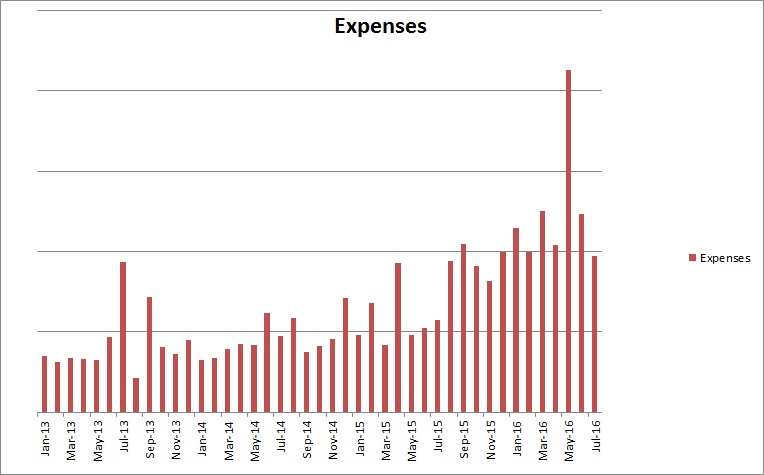
Now, I only track my expenses on a monthly basis and I found that even after I stop tracking my daily expenses, the effects are not that much of a difference, only a slight increase except for a month where I went overseas.


Expenses has gone up over the years and I'm actually happy that it has happened. The irony is when expenses went up, my income went up as well.

Now, back to what will cause us to be poorer each day. The answer is LOANS. There are many different types of loans or what we call as debts but some of them work differently from each other. Let's look at some common loans and see whether will they actually make us poorer?


Car Loans

Car loans is quite common in Singapore. Due to the high price of cars now, how many people can actually affoed to pay that $100,000+ in cash for that car?


SGCarMart has a good new car loan calculator which i'm using for the below illustration:

New Car Model: Toyota Vios 1.5 Elegance
Car Price: $104,888
Loan Amount: $73,422
Interest Rate: 2.28%
Loan Tenure: 7 Years

From the above example, the monthly instalment will be $1014. Total interest paid at the end of 7 years will add up to $11,718. This is 11.17% of the original car price. This is still 2.28% per year even though we are paying a monthly instalment whic reduces the outstanding loa amount. This is because car loans interest are always calculated base on the initial loan amount instead of the remaining loan amount


Housing Loan

Housing loan is even more common in Singapore. We can choose not to have a car but we need to have a roof over our heads. For this illustration purpose, I'll be using a mortgage calculator from MoneySense.

Price of HDB flat: $340,000
Loan Amount: $306,000
Interest Rate: 2.6%
Loan tenure: 25 years

For the above example, the monthly instalment will be $1388.23. Total interest paid at the end of 25 years will add up to $110,468.61. This is 32.49% of the property price value.

The interest paid is quite scary to be honest. This means if your property price is not more than $416,469 in 25 years and you sell it, you'll be making a loss instead. Nevertheless, if we calculate the average interest paid yearly, it is only about 1.29%. This is because housing loan interest are amortised. This means the interest is calculated based on the remaining loan amount yearly as compared to a car loan which calculates interest base on the initial loan amount.


Credit Card Debt

Credit card is not considered a loan but it is a debt if we missed the payment or did not pay the bills on time. Let's see how credit card interest is calculated and what happens if we did not pay the bills.

Credit Card debt: $1000
Interest rate: 24% p.a (2% per month)
Years of Owing: 3 years


Base on the above example, if we did not pay a single cent on the amount owing, the $1000 debt would grow to $2000 in 3 years. This is double of the initial amount of $2000. The reason why it doubles is because interest is compounded on a monthly basis. To calculate how long it takes for your credit card debt to double, you can use a simple method called the rule of 72. By using 72 divided by the credit card interest rate per annum, you will get the number of years which the credit card debt will double. In the above example, it is 72 divided by 24 which is 3 years.

Another thing to note about credit card is if we were to make partial payment, the payment paid will be used to pay for the interest first before it is used to pay for the outstanding amount. For example if the credit card debt is $10,000 and interest is $240 per month, if we just pay $240, the initial debt of $10,000 will not reduce at all. We are just paying interest every month for as long as it goes without reducing the debt amount.

Conclusion

Loans or debts can cause us to be poorer without us realising it. Our daily expenditure or spending money on food or clothes can be consciously tracked but for loans, it is sometimes hard to visualise exactly how much money we actually pay for the interest.

For the 3 different loans, all 3 of them work differently:

  1. For car loans, the interest is base on the initial amount
  2. For housing loans, the interest is base on the reducing balance
  3. For credit card debts, the interest is base on the outstanding amount compounded monthly

Before committing to a loan, we should know how much interest we are paying. For debts, we should not get into any in the first place as it can be very hard to get out base on the example above.

Make the right financial choice today!

Enjoyed my articles? 
You can Subscribe to SG Young Investment by Email 
or follow me on my Facebook page and get notified about new posts.