Tuesday, April 29, 2014

Investing during a market crash

I haven't been blogging on my investments for a couple of weeks now. Other than the many company annual reports which filled up my letter box, the market has been rather uninteresting of late. My investments have been status quo with no additional buying or selling done.  Somehow I'm waiting for the market to go lower for more buying opportunities. If the market crashes, it's even better since i'm not even heavily invested in the first place.

Buying during a market crash may be the best way to make money in the stock market. But how many people actually dare to buy during a crash? During a market crash, there will be many negative news on the economy. Let me share with you my experience during a market correction. I would not classify this as a crash as its considered mild compared to a real crash.

This was during the year 2011 where there was a possibility of a huge economic crisis looming. First it started with Greece defaulting on its debt then it spread to other neighbouring countries such as Spain, Portugal, Italy, France etc. Some of these countries were the top few economies of the world and they were in trouble. Many economist predict something disastrous is going to happen. The US market dropped almost everyday with a 600-800 points drop on the Dow Jones Index on some days. I saw the biggest decline on the STI i've ever seen with a 100 points drop in a single day.

It is hard to buy any stocks when there is so much negativity. But those who did invest during these times would have made a huge profit and return on investment. It is therefore important to have a war chest(cash) on standby to take advantage during a market crash. How did these individuals manage to buy during times of trouble? I believe to have the courage to do that, we need to trick ourselves into buying and also have a clear strategy.


The trick yourself strategy

The main reason why people are not investing in times of trouble is because of fear. Fear is all in the psychology of the mind. You want to buy a stock but you may think whether this stock will drop further? The way to counter this fear of a stock dropping lower is to divide your capital into different tranche. Do not buy a falling stock at one shot with all your capital. Buy some first and buy the rest if it drops lower. But how to know at which level to buy and how much to buy?


Stocks typically drop around 50%-60% during a market crash

Typically, during a market crash, most stocks drop a maximum of around 60%. Of course this company must have strong fundamentals and a good track record of profits. A bad company can lose everything and go bankrupt during a crisis. Knowing the stock price of good companies drop a maximum of 60%, we can divide our war chest into 2 tranches to buy first at 30% drop and the second at 50-60% drop. Or we can divide our war chest into 3 tranches to buy the first at 20% drop, the second at 40% and the third at 50-60% drop. With this, we will always buy something during a market correction or crash and at least make a decent profit. It is better than trying to predict the exact low of the market and end up not buying at all which most people do. Many end up waiting for the stock price to go lower and scared that the stock price will continue falling. The psychology of this state of mind prevents one from buying stocks at a low.


Real life examples

Technical analysis can also be one way to guide us on our entry buy price. By looking at charts, we can know how much a stock typically falls during a market crash. Below shows the chart of the company called OCBC bank in Singapore. During the 2007 financial crisis, this stock fell from $9.45 to a low of $4.14. That is a 56% drop. If we had bought first at 30% drop which is $6.41 and second at 50% drop which is $4.75, the average price will be around $5.58. The stock recovered from the low of $4 plus to $7 plus in just 3 months. You would have made a profit if you dared to buy during the crash.

If we look at the year 2000 dot com bubble crisis, this stock also dropped around 56%. If we had used the same strategy, we would also have made a profit.

OCBC


Let's take a look at the next company, Singpost. This is also a stable company with strong fundamentals. In the 2007 financial crisis, this stock dropped about 53%. Applying the same strategy to buy first at 30% drop and the second at 50% drop, the same profit would apply. As we can see the stock price has already went above the high of year 2007.

Singpost


There are cases where the stock price of a company is cyclical in nature as seen in the company SIA(Singapore Airlines) below. This stock dropped 60% during the 2007 financial crisis. For cyclical stocks, we can still deploy the same strategy of buying in 2 or 3 different tranches but it will be futile to hold the stock throughout unless you invest solely for the dividends only. The stock price of these cyclical companies fluctuate up and down a lot and goes in a sideways fashion. Most of the time its better to sell it off for some profits before the next crash comes.

SIA


There are many other factors to consider when buying a stock and each stock may behave differently. This blog post would not be able to cover all strategies. By allocating our assets efficiently and minimizing our risks by diversifying into a few other stocks, we can all make some money from the stock market. When the market is all good and prices are climbing, always remember to stash away some cash (war chest) to invest during a crash. As the market goes higher, i actually lessen my exposure to the market and keep more cash. There will always be some form of correction which will allow us to buy stocks at much cheaper prices. I have prepared myself to 'trick my mind' into buying during a market crash. I know at what levels to buy and which stocks to buy when the time comes. Being prepared may be an edge to win this battle. Are you prepared for it?

Enjoyed my articles? 
You can Subscribe to SG Young Investment by Email 
or follow me on my Facebook page and get notified about new posts.

Related Posts:
1. Buying the company on the streets (Part 1) - Discovery stage
2. How to pick stocks (Part 1) - Economic Moats
3. Understanding financial statements (Part 1) - The income statement

Sunday, April 27, 2014

First time lunch experience at Tim Ho Wan

I've long heard of Tim Ho Wan for its famous dim sum when its first opened the first outlet at Plaza Singapura around last year. Tim Ho Wan is a popular Michelin starred Dim Sum restaurant in Hong Kong. Singapore is its first overseas outlet. I heard people queued for as long as 3 hours just to get seated in the Plaza Sing outlet when it first opened. I was quite put off by the long wait so i thought now would be a good time to go there since it already has 4 outlets in Singapore and probably the queue will not be that long after 1 year.


I went to the Bedok mall outlet with my family at around 1:45pm just now. I thought there won't be many people there by this time but i was absolutely wrong. The restaurant was fully packed and there were about 20 people queuing outside. We actually walked off thinking the wait would take at least an hour. Luckily as i was walking off, i saw about 10 people being brought inside the restaurant and the queue shortened quickly. Decided to queue now since not too many people. Within 10 mins even before we decided on what to order, we were already brought into the restaurant. They had a very good system of organising seats for its customers. Every thing was in proper order.

You may be thinking why am i blogging about food and more so expensive restaurant food in my finance blog? Well, i don't usually eat at restaurants except when i give my parents a treat like this time. This is one of those occasions when i'm less concerned on money. Its good to splurge on food especially when it comes to good food with your own family. Good things are meant to be shared with your loved ones aren't they?

Tim Ho Wan is dubbed the cheapest Michelin starred restaurant in the world. I would say it is affordable for an average income earner. Michelin starred restaurants food are quite expensive elsewhere. You may wonder what's so special about Michelin star? I did some research and here are the findings:

"The term "Michelin Star" is a hallmark of fine dining quality. Michelin awards 0-3 stars on the basis of anonymous inspections by reviewers. The reviewers are supposed to concentrate on the quality, mastery of technique, personality and consistency of the food, not on interior décor, table setting, or service quality." 
 "The reason Michelin stars are so coveted is that most restaurants receive no stars at all. For example, in the Michelin Guide to France 2009, 3,531 restaurants are included, but just 548 received a star. Most of these restaurants -- 449 -- received one-star, 73 received two stars, and 26 received three."

It seems like not many restaurants have been awarded even one star. Having just one star is already an achievement. So did this Dim Sum restaurant lived up to its standard?

Here are some of the food i ordered:


This was the famous BBQ pork Bun. It's so nice and round that it would capture the attention of anybody who walked past. The bun was really soft with juicy BBQ pork inside. 3 buns for $4.50. It was special and unique in its own way. Don't think i've tasted any other bun as good as this in Singapore before. A must try if you're there.


The inside of the bun. Juicy BBQ char siew pork. (Pardon my dirty plate)


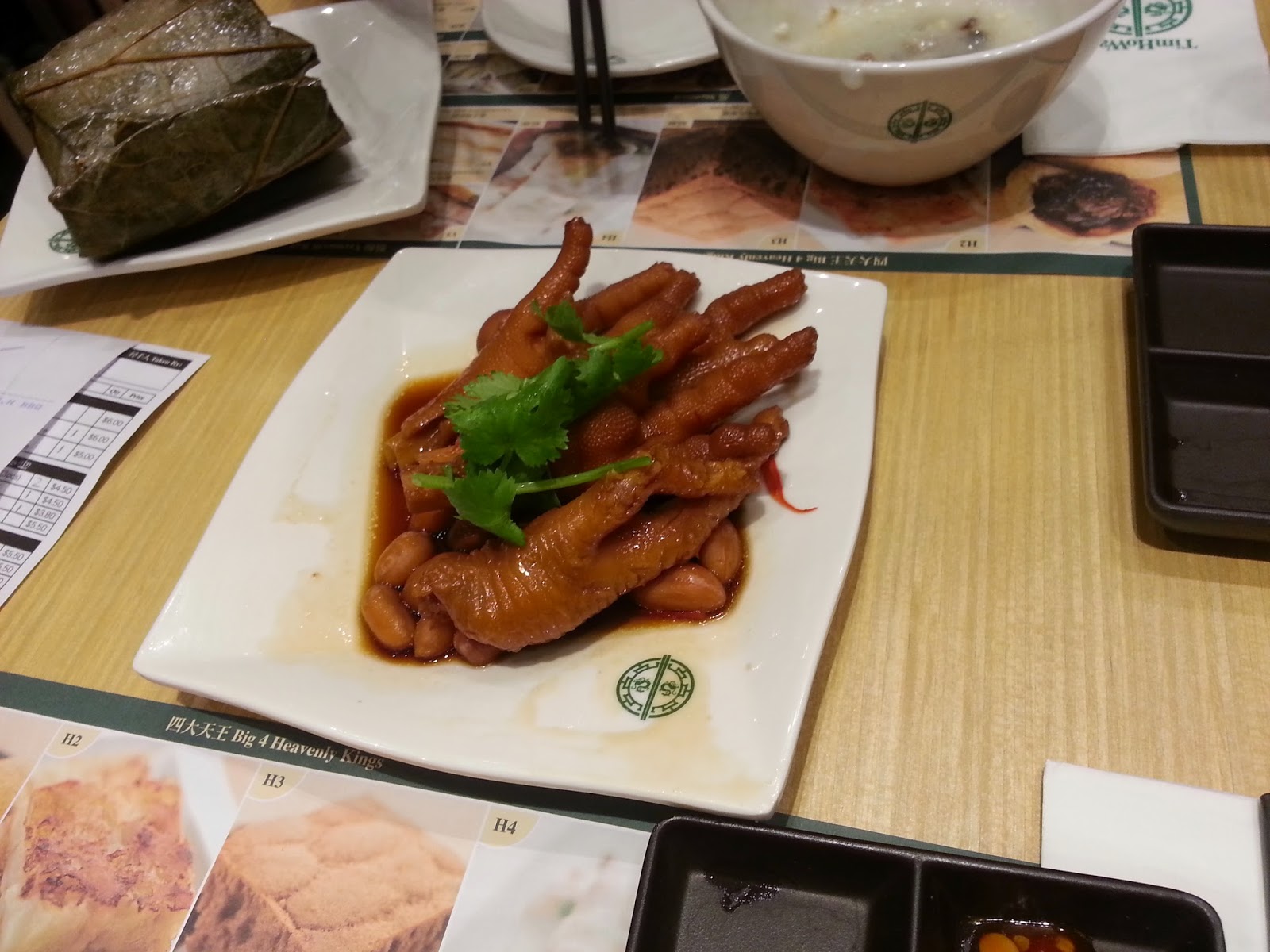
This chicken feet was a chef recommendation in the bedok outlet. Cost was $5/plate. To me this was nothing special. I've tasted better chicken feet elsewhere.


Glutinous rice with lotus leaf. $5 for this one. This was quite good. The rice is seasoned perfectly and the texture was smooth. Recommended to try when you're there. 


Prawn dumplings for $5.50. The filling was really full of fresh prawns. Quite worth the money. However to me, the taste was only average. Could be seasoned a little bit better. 


This was a famous egg cake which i've seen other bloggers recommend. $3.80 for this one. I'm not a fan of cakes or bread stuff but i have to say this is really fluffy and soft. Taste was perfect with just the right amount of sweetness. However, i would think the cake is a little on the dry side. Not sure if its suppose to be like this? 


In total, i ordered a total of 11 items with one chinese tea drink each. Some items i did not take pictures of it. Total cost was $68.62 including GST and service charge. Not too expensive considering the good service and the quality of the food. 

Other items i ordered include wasabi fried prawn dumpling, fried hong kong style noodles, beef vermicelli, carrot cake and pork congee. 

Another food i would strongly recommend is the pork congee or some may call it porridge. It's $4.20 for a small bowl but i would say its worth every bit of the price. The taste was just fantastic and the congee just melts in your mouth. I saw almost every table ordered this.

Overall, the experience was good. The restaurant was not understaffed and food came in fast even though the place was fully packed. The staff were polite and didn't rush us at all. Can see that they are trained professionally. Thank you for reading my first attempt on food review. Hope you liked this little twist in my blog. 

Enjoyed my articles? 
You can Subscribe to SG Young Investment by Email 
or follow me on my Facebook page and get notified about new posts.

Thursday, April 24, 2014

Getting the Courage to Invest—Taking Calculated Risks [Guest Post]

French novelist André Malrauxonce said, “often the difference between a successful person and a failure is not one has better abilities or ideas, but the courage that one has to bet on one’s ideas, to take calculated risk – and to act.”

Risk is something inherent in investing. Some investments are so risky that the possibility of losing all of your investment is possible. The thought of losing all of one’s investment, or even just a part of it, can easily discourage some people from making an investment, which is rather unfortunate.


It’s easy to just flock to the safety of just saving your money in a bank. You could be thinking that your money is safe and even insured by a government agency in a savings account. It even earns interest, so why should you still bother to invest?

One way to see it is this: the money in your bank, aside from earning only minimal interest, is actually losing some of its value. Savings account interest rates these days earned are so small that many lag behind the inflation rate.

An example of this is the situation in the UK in June last year where depositors actually needed to find a savings account that has an interest rate of at least 3.38% to beat the inflation rate. If depositors don’t find a higher rate, the value of their money basically erodes.

Sure, you could work hard and earn more money, but if you really think about it, how long can you stay productive? A smarter way to go about protecting the value of your money is to make it work for you through investments.


Studying Your Investment Choices

As we’ve mentioned earlier, investing has inherent risks. But there are so many investment options that you can take steps to minimize these risks and still realize positive returns for your investments. 

Stocks and bonds are common investment instruments that you could look into. You have others that pose smaller risks, such as blue chip stocks and government bonds.

Having a diversified portfolio has always been a recommended risk management method. It basically means putting your money in different types of investments. It’s following the age-old advice of not putting all of your eggs in one basket, so if for instance you invest in stocks, don’t invest in just one company. You could further diversify your portfolio by investing in the stocks of companies from different geographic areas to further shield you from any regional political or economic conditions that can affect the stock’s value.

Going into business is also considered an investment. You invest your time, effort, and capital to start a business and there are many possible factors that could play a role in the success or failure of your venture. There’s the regulatory risks such as the government suddenly raising taxes so that you would find it hard to make a profit or risks such as a road construction right in front of your business just a few months after you open that severely cuts foot traffic to your establishment.

Before making any investment, it’s thus essential that you first study all of the aspects of the investment. This is the part where taking a risk becomes taking a calculated risk. This is the idea that Malraux was talking about which differentiates a successful person from one who is a failure.

Funding Options For Starting Your Investment

Once you decide to invest in stocks and bonds or even start a new business, you then have to choose how to go about investing. Ideally, you should always have an emergency fund saved up in a savings account that you could tap into. This amount should be enough to sustain you for eight months at least even if you don’t have any other source of income. Keeping an emergency fund helps minimize your investment risks.

Money in excess of that emergency fund can be invested but there are other sources of funds, such as getting a personal loan, but you should think twice before taking this option since the profit that you may earn from your investment may not be high enough to cover the interest payment that you need to pay on top of these loans.

There are also business organizations that you may want to tap since there are some that offer business assistance for people like you who are interested in starting their own business. Or you could go big and seek investments from venture capitalists and angel investors.

Studying your investments well and your options should any unforeseen events happen can help you make a calculated risk when investing. Malraux emphasized this but all this planning is studying will not bring you success unless you learn how to act on it.

Author’s Bio
Ryan Del Villar works as a Content Strategist for MoneyHero. He is also a freelance online reputation management writer.