Showing posts with label my investments. Show all posts

Monday, August 24, 2020

Life and Investing In the Midst of A Recession

News of what was to come came in early January 2020. Working in healthcare, I first heard of the then Wuhan virus in early Jan. Infectious disease experts in Singapore were already starting to monitor the developments in China very early on and preparing for what was to come. We didn't have the mood to celebrate Chinese New Year and the worrying part is when people around the world travel to different parts of the world during the CNY holidays causing the virus to spread.

In the midst of CNY, I was busy preparing slides for manpower planning for COVID-19 support. I had to work till midnight for several days. The CNY holidays were totally disrupted for me. The preparation work continued for the rest of the 15 days of CNY and DORSCON was raised to orange in Singapore even before the 15 days CNY was over. I remembered some of my colleagues had arranged reunion dinner with their family on that faithful night but all plans were disrupted. 

The virus was officially named 2019-nCOV in February and then changed to COVID-19 thereafter. The events happened very quickly and caught many by surprise. It sent shock waves to the stock market and every stock went into free fall mode. Many people, including me started to deploy our warchest to buy some stocks at good bargain thinking this virus will pass by in just a few months. The only comparison we had was the SARS virus back in 2003 and the world got out of it in just a few months. 

Little did I know that COVID-19 would cause such massive damage to the economy as compared to SARS. Fast forward 7 months into COVID-19, we are still far from over from this crisis. Retrenchments are intensifying and pay cuts become a common occurence. Our borders are still mostly closed even though there's some good news now that our borders are starting to reopen to revive the tourism, hospitality and aviation sector. This sector contributes about 5% to Singapore's GDP which is somewhat significant. Furthermore, there are repercussions if there are no tourists in Singapore. Tourists contributes significantly when they spend in our country. Without them, many businesses suffer a drop in income and many had to close down as what we have seen. Singapore's domestic market is still too small to sustain our economy for the long run. 


Is this still the best time for investing?

Nevertheless, I still think this is the best time for investing. Many investors in the past have said that they will take advantage and find opportunity to invest when a crisis happens. I too was looking forward to a crisis so that I can invest more. When the crisis really comes, it was easy deploying cash into stocks at the start but as the crisis drags on and your portfolio continues to see losses, we also start to doubt our investment thesis whether is it correct or should we even be investing now. I had self doubts too investing in this crisis. Almost all companies have cut dividends. The more than 10% dividend yield we see for some companies when the stock price drop becomes less than 5% now after they cut dividends. Its almost like everything is going against you.  

The good thing now is the companies I invested in, so far non have collapsed in the midst of the crisis. This is especially important as some companies will surely not make it and file for bankruptcy. Big names like Muji, GNC, Hertz have filed for bankruptcy in the US. Recently, Genting HK which owns Dream Cruise and Zouk Singapore also defaulted on its loans. Car sharing firm Smove in Singapore also collapsed. In times like this, it is really important to invest in strong companies with good balance sheet to ensure they can ride out the storm. 

This storm may take some time to pass. Perhaps another 6 months to 1 year from what I read so far. For Singapore, we should be looking at a vaccine nearer to the end of 2021 which is still quite some time from now. For now, we still have to get use to living this different life we have since the start of 2020. I am still accumulating stocks which are at depressed prices now. I still believe in REITs which I had accumulated more of Frasers Centrepoint Trust, Capitaland Mall Trust and Lendlease REIT to larger positions. I have also invested more on hospitality REITs such as CDL Htrust even though the hospitality sector may still take some time to recover. However, the REITs that own hotels are still surviving with profits as they cater for visitors on SHN and foreign workers. I believe once COVID-19 is under control, people will start travelling again. There is definitely pent up demand for travel again.

I also bought more Netlink Trust as they continue to generate dividends and appear unscathed from the crisis. For recovery plays, I bought in Comfortdelgro at $1.35 as I feel they should be the first to recover and the stock price is really attractive. I also invested in banks such as OCBC and DBS to ride on the banking giants at attractive prices. Lastly, I also made my first investment in US stock in Alphabet Inc which is the Google company we know. 

Nevertheless, my portfolio is still down 15% YTD while the STI is down almost 20%. This is definitely not a good year for investment and who knows how long this will continue on. Reference to the past during the 2008 global financial crisis, the stock market took about 7 months to 1 year to bottom out and recovered furiously thereafter to reach another peak in 1-2 years. I feel the stock market has already bottomed out and bad news are already priced in, not withstanding another shock to the world again. There may still be another slight dip but it should not be as bad as what we have went through thus far. 

Therefore, I do feel this is the best time to accumulate good companies in the next few months. We are so far about 5-6 months from the stock market drop and if history do repeat itself, then it should take another 5-6 months to see recovery. Remember, the stock market is always 6 months to 1 year ahead of the economy. So, the market can be recovering when retrenchments are intensifying and at the peak. This is the nature of investing. 

Life has not been an easy one for many of us this year and it may get worse before it gets better. Nevertheless, when we get out of this crisis, we will become better and life will be back as normal again. As with all other crisis, nothing will be permanent. Those who look for opportunities during a crisis will become better and emerge stronger. Its up to us to take action now in all aspects of our life. 

Monday, November 4, 2019

Netlink NBN Trust - A Strong & Stable Investment

Netlink NBN Trust has gotten the attention of investors lately but I think its still early in its developments. I'm personally invested in this stock which I believed will do well in the next 2-3 years. They also just reported their financial results for Q2 and 1H FY2020 where we saw revenue and profit after tax increased by 5.3% and 17% respectively.


Background of Netlink NBN Trust

Netlink NBN Trust is not your typical limelight stock like REITs which owns properties where we can see the physical infrastructure. Netlink's infrastructure is hidden mostly underground where they are in the fibre business making money from every residential fibre connections, non residential fibre connections and non building access points (NBAP).


Fibre is an important aspect in our world today. I was once a telecommunication engineer and I saw the growth of the fibre business to a huge extent when 4G was deployed. In today's context where we need to transmit large data through telecommunication networks, the fibre business will definitely keep growing. When 5G comes, this growth will explode and that is where I think Netlink NBN Trust will benefit greatly.


How their business make money?

To know if Netlink Trust is a good investment, we need to first understand where they make their money from. Basically, they generate revenue from 2 primarily revenue streams:
  1. one-off installation and/or patching charges (as applicable) for each termination point (upon the initial connection) or service activation
  2. a monthly recurring connection charge
Basically, they make money through charging one off charge and also a monthly recurring charge. This means everyone with a fibre connection is renting the fibre from them by paying a monthly rental fee.

The largest part of their revenue comes from residential fibre connections. This means you and I are both contributing to Netlink's revenue as long as you have fibre at home. Netlink currently has 1.41 residential connections. The second largest of their revenue comes from non residential fibre connections. They have 46,742 non-residential connections currently.

Here's an overview of Netlink NBN Trust's revenue streams:

One thing to take note of is that the prices of fibre connections and the recurring fees are regulated by IMDA under the Regulated Asset Base (RAB) model. This is effective from Jan 2018. During the last review, IMDA has set fibre connection prices such that Netlink will make a 7% pre-tax return on its past capital investments based on the RAB model. These prices will be reviewed every 5 years so the next review will probably be in 2022.


The next growth segment

Fibre has a lot to grow as we consume more data and especially when Singapore is moving towards becoming a smart nation. Being a smart nation, large data will be transmitted everywhere which means more fibre connections will be required.

We will see more CCTV systems, weather monitoring systems, autonomous vehicles and many more such services which requires more fibre connections. This will fall under their non building access points (NBAP) which makes up only 1.9% of their revenue streams currently.

Let me get a little technical to explain why more fibre connections will be needed in the future. In wireless technology, there are various frequencies which are used to transmit data through telecommunication networks. They can operate in 900MHz, 1800MHz, 2100MHz, 2800MHz etc. The lower the frequency, the longer the distance which data can be transmitted but the bandwidth will be lower. With higher frequency, the bandwidth is greatly enhanced but the distance which data can be transmitted is much shorter.

For 3G, it mostly uses 2100MHz where data can be transmitted at quite high speed with good distance. For 2G, it mostly uses 900MHz where distance is very good but speed is very low. For 4G, 2800MHz is used where the speed is much higher but distance is short. This explains why our 2G coverage was much better as compared to 3G or even 4G. To overcome the distance problem due to using higher frequencies, Telcos have to build more mobile base stations to enhance the coverage and still provide the speed to customers. Every mobile base station will need to be connected to fibre connection points which generates more revenue for Netlink Trust.

For 5G, IMDA released a factsheet on 5G public consultation 2019 which shows what frequency 5G will operate in. The frequency spectrum identified are 3.5GHz (3500MHz), 26GHz (26000MHz) and 28GHz (28000MHz). 5G uses this technology called millimetre wave or “mmWave” bands which brings ultra high speed to us. 5G is able to support 20 times faster speed as compared to the current 4G and also has the ability to support large-scale machine-type communications which will propel Singapore into a smart nation.

Now, knowing that 5G will use much higher frequency, the distance covered will be much shorter so more mobile base stations will have to be built and these base stations will most probably be built lower to the ground on lamp posts and streets. As mentioned above, each mobile base station will need a fibre connection so we will likely see a huge increase in NBAP connections revenue for Netlink when 5G starts rolling out. This will be in the next 2-3 years.

Here's a good overview of the 5G network set up to show there will be more NBAP connections:

Adapted from: https://mavenir.com/buzz/blog/5g-business-case-works
The red antennas you see above are the possible 5G base stations which will be setup. All of these connections will require fibre connections which will benefit Netlink Trust greatly.


Q2 and 1H FY2020

Even before 5G comes, Netlink Trust is already delivering a good set of results for Q2 FY20. Residential connection increased 2% which most probably come from migration of cable users to fibre and also new residential buildings coming up in Singapore. If you've read the news, you would have saw that Starhub is stopping its cable service and migrating all their customers to fibre. This is good for Netlink Trust.


Distribution income (Dividends) increased by 3.3% QoQ with current yield of about 5.3%. Dividends is expected to be stable as they have a predictable recurring income stream. With the next growth segment coming up, I believe Netlink Trust will continue to do well. The downside will be that the government revised its pricing model downwards but that should not happen for the time being as the next review will be in 2022.

Enjoyed my articles? 

or follow me on my Facebook page and get notified about new posts.

Wednesday, April 17, 2019

Is 6% Dividend Yield Achievable For A Singapore Market Investment Portfolio?

In my previous post on The 10 Years Financial Independence Target, I laid out the strategy to compound our money to reach financial independence in 10 years. The strategy involves having a dividend yield of 6% in the investment portfolio. There are quite a few questions on whether 6% dividend yield is achievable? Also, how do we get that 6% dividend yield?

In my years of investing experience, I've learnt that it is indeed achievable to get 6% dividend yield in our investment portfolio. Over the years, I've learnt to pick some good stocks that have generated on average 6% or more dividend yield for my portfolio. Some of these stocks I've held it for many years and they are still generating stable and good dividends for me. In fact, the dividend yield should  increase over the years if its a good stock and of course the price of the stock will increase too.

Here is a glance of some of the stocks which are generating good dividends in my portfolio:


StockAvg Price when boughtDividend Yield on portfolio
Starhill Global Reit$0.686.48%
Frasers L&I Tr$1.036.95%
Suntec Reit$1.656.04%
CDL HTrust$1.297.12%
Far East HTrust$0.636.35%
Frasers Cpt Tr$1.956.16%
Ascendas-hTrust$0.728.25%
CapitaMall Trust$1.906.04%
Frasers HTrust$0.786.02%
CapitaCom Trust$1.326.59%
SingTel$3.504.97%

Above are 11 stocks in my portfolio which are generating on average 5% and more dividends. With the exception of Singtel, all other stocks are generating 6%-8% dividend yield for me. Unfortunately, most of the stocks are not giving more than 6% dividend yield based on current price. I bought most of the stocks when the price was significantly lower. 

If you've missed the boat, fear not because there will always be an opportunity to buy stocks at lower prices again. When the market is bad, that is the time to buy. But, it is important to pick good stocks so that they can ride out the bad economic situation at that time. 

Let me share some tips and what to look out for when identifying companies to buy based solely on my experience to achieve 6% dividend yield.


1. REITs and Business Trusts are good stocks to get dividend income

The first thing you will realise is that REITs and business trust is the answer to get higher dividend yield. As compared to blue chips such as Singtel, DBS or other big companies, the dividend given by REITs and business trust is mostly higher due to the fact that they are income generating assets. They own assets which they rent out to get rental income. REITs also have to give out at least 90% of their income to shareholders in the form of dividend.


2. Sustainability of rental income affects dividend yield

As dividends are given out from the rental income which the REIT or business trust receive, the sustainability of it is important. If you invest in a retail REIT such as Capitamall or Suntec, the retail sales, traffic flow and the positions of the malls will affect its rental income. Economic changes will also affect its rental income. 

For example, there has been discussions that retail sales will be affected due to the emergence of online shopping. If lesser people shop at the stores, the stores will have lesser income and thus may not want to renew their lease. If the shop space is left empty, then rental income will be affected. 

The location of the malls is also important when it comes to sustainability of rental income for retail REITs. For example, Frasers centrepoint trust has malls which are located in sub urban areas such as Woodlands causeway point, Yishun North Point etc. The malls are also mostly located next to MRT stations. This brings a lot of shopper traffic to their malls and thus they are able to attract better tenants who are willing to pay more rental. 

Other REITs such as commercial REITs, hospitality REITs and logistics REITs will also have factors affecting its rental income. Commercial REITs rental income is affected mostly by economic market conditions, hospitality REITs are affected by the number of tourists who come and stay in Singapore or the supply of new hotels and logistics REITs are affected by economic market conditions also. This is just a general statement but if we really want to dive deeper, there are lots of factors for each REIT to talk about. 

Master lease is another factor to look at for sustainability of rental income. Starhill global reit which owns Ngee Ann City has master lease with Toshin which owns Takashimaya in the mall itself. This has contributed to stable income for the REIT as there is certainty that the tenant will continue to pay its rental income under the lease contract. 

3. Is the REIT able to generate higher rental income progressively?

Besides the sustainability of the rental income, we should also look at REITs and business trust which can generate higher rental income. This is called rental reversion. Lease of the tenants do expire according to their contract. When the lease expires, tenants may renew their lease with the REIT or business trust. Good REITs will be able to generate positive rental reversion for many years. An example of this REIT is Frasers Centrepoint Trust. They have managed to generate positive rental reversion since 2007. This is 12 years and going strong. Rental reversion is the metric that shows whether new leases that were signed have higher or lower rental rates than before.

Another way the REIT can generate more rental income is through yield accretive acquisition and Asset Enhancement Initiatives (AEI). REITs will often look out for good properties to take over. A recent big acquisition is by Frasers Centrepoint Trust where they took a major stake in PGIM Real estate AsiaRetail Fund which owns the Asiamalls in Singapore. Frasers Centrepoint Trust also did an AEI few years back where they expanded North Point in Yishun and this has resulted in higher rental income due to more space which they can rent out. 

For commercial REITs such as Capitaland Commercial Trust, they did a series of yield accretive acquisition such as acquiring Asia square tower 2 and they are doing AEI on Raffles City which will increase their rental income. Hospitality trust such as Far East Hospitality is expanding with its newly built Outpost hotel Sentosa opening this month. This will add to its income which it gets from its hotel rooms and also events management revenue. 


4. Make a trip down to the REIT's property

We should make a trip down to the REITs we invest in especially those that are in our home country. Having a look and feel of the human traffic, business activity of the property itself can tell a lot about whether its a good investment.

For retail REITs, most likely we would have visited before so what makes the malls stand out from the rest of its competitor? Some retail REITs are smart enough to take advantage of the rise of ecommerce such as Capitaland Mall is opening the new Funan mall in June 2019 with drive through click-and-collect and hands-free shopping service, where shoppers can choose to either pick up their purchases at Funan’s concierge when they are done, or have their shopping bags delivered to their homes.

For hospitality REITs, we can make a trip down or read the reviews on online websites such as booking.com or TripAdvisor. The reviews can tell a lot about its business activities.

For commercial and industrial REITs, it gets a little more tricky as we can't really visit these commercial offices or industrial buildings. But, we can still look at reports to gauge the occupancy and business activities. For this kind of REITs, most of the time they are more affected by economic cycles so its important to know what is going on around the world. Reports from CBRE are good sources of information to read more on commercial property activities.


5. Never over pay for a REIT

Buying REITs is like buying properties. When I invest in REITs, I will make sure I buy it at a reasonable price. You can see whether the price is reasonable by looking at the NAV or the dividend yield. The NAV is the net asset value which is the net value of all its assets (mostly properties for REITs). The dividend yield will tell you how much rental income you are getting and whether its worth the investment.

For example, when we buy a physical property for investment, we will also look at the location, then the reasonableness of the price (whether its below or above valuation) and then we will look at how much rental income we will get. Taking the rental income divided by the price we pay, we will get the % return. When investing in REITs, we should approach it like buying a real property also and most of the time this will make sure we get good value out of our investments.

It takes patience to get good value on our investments. Some of the REITs I waited a few years before I finally invested in it. When the price is right, I will know at that time because I've been reading up and researching all along.


In Summary
From my own personal experience, investing in REITs and business trust has been a rewarding experience. While waiting for the REIT to continue growing, I get dividends over the years to have some certainty on the return on investment in my portfolio. Even if the REIT does not do well later, the loss will be cushioned by the dividends we received.

Within the investment, I also buy and sell the REIT along the way to take some profit when it goes up and buy again when the price goes lower. 6% dividend yield and return on investment is possible and I've managed to achieve this consistently over the past few years. There are ups and downs over the years but the overall % return should still be there. Hope this post has helped you to get some insights on how to achieve 6% dividend yield in your investment portfolio.

Enjoyed my articles? 

or follow me on my Facebook page and get notified about new posts.

Monday, December 24, 2018

An Undervalued Stock Closely Related To Christmas

Christmas is here and the year 2018 is coming to an end. Many people are buying gifts as its the season for giving. While everyone is busy shopping, have you noticed one stock that is undervalued and closely related to Christmas?

This stock is a REIT and most of its properties are located right at the heart of central Singapore. If you've been to Orchard road to see the Disney lights or to do some Christmas shopping there, chances are you might have passed by the properties owned by the REIT. This REIT is non other than Starhill Global REIT.


An Undervalued Stock Closely Related To Christmas - Starhill Global REIT

Starhill Global REIT has 2 properties in Singapore, 3 in Australia, 2 in Malaysia, 2 in Japan and 1 in China. 62% of its revenue comes from Singapore which is why the Singapore market is especially important for this REIT. Due to lower business sentiments and poor retail and office outlook environment in Orchard, the stock price took a beating and fell to a 5 year low as seen in the chart below.


With the stock price trading at this low, it offers investors like you and me to invest in this REIT at a much greater discount. Before we get into the valuation of this REIT, let us first look at its portfolio of properties to familiarise ourselves before we make any investment decisions.


Properties owned by Starhill Global REIT

The first property owned by Starhill Global is Wisma Atria. This shopping mall should be familiar to most Singaporeans. From Orchard MRT, if you take the underpass and walk towards Takashimaya, you will definitely have to pass by Wisma Atria. When I was there about 2 weeks ago, there were so many people that it became difficult to walk. At the link-way of Wisma Atria, crowds have to be stopped by security in order for the mall to control the human traffic flow.


The next property it owns is Ngee Ann City. This property is also located near to the MRT with direct underground links. The largest tenant inside Ngee Ann City is by Toshin Development Singapore Pte. Ltd. They own Takashimaya in Singapore which most of us should know that they take up quite a huge area of retail space. Toshin development Singapore has a master lease with Ngee Ann City till 2025 so this will keep the rent they receive steady for the next few years.


Occupancy rate for retail in Singapore is 97% as at 30 Sep 2018 and committed occupancy will rise to 99.7%. For its office portfolio, occupancy rate is 92.9% with committed occupancy at 95.3%. Its top 10 tenants contribute to 58% of portfolio gross rent as seen below.


For Australia, which is Starhill's second largest portfolio contribution to its revenue, its occupancy is not that good at 88.6%. It owns properties in Perth and Adelaide.

Singapore office recovery for Starhill Global REIT

Besides retail, Starhill Global has an office portfolio too. Occupancy for office portfolio was at a low of 83.5% in Sepember 2017 and recovered to 95.3% in 2018. NPI jumped 9.7% year on year which is quite impressive.


Attractive Dividend Yield and Valuations

Investors of Starhill Global REIT get quite an attractive dividend yield on their investment. Dividend yield is about 6.67% at current price of $0.675. It is trading at a price to book ratio of 0.75x which represents a 25% discount to net asset value. Its NAV is at $0.91.

Of course when investing, we can't just look at dividend yield and book value. Although at current valuations, this stock is definitely attractive, there lies risks in this investment. It is largely dependent on the retail outlook in Singapore as this makes up most of its rental income stream. Not just retail outlook in Singapore but retail outlook in Orchard in particularly.

Orchard is a tourist area and the retail environment is very much dependant on the number of tourists arrival and visits to Orchard in Singapore. Tourists arrival and spending is still on an uptrend which I believe will benefit Starhill Global REIT. Moreover, the Singapore government has said there are plans to reinvent Orchard road to attract more locals, visitors and tourists to come.

The bottom may be near for this REIT as its stock price has fell significantly over the past few years. At current valuations, I think this is a REIT to watch out for any potential recovery and catalyst to propel it upwards. One of the catalyst is the proposed development at Wisma Atria where there is unutilised GFA of up to 100,000sqft. This is pending approval from the relevant authorities and partners.

I have initiated a position in Starhill Global REIT as the dividend yield is decent and it is trading at a discount to book value. At this level, I believe the risk reward ratio is within my tolerance level and I will look to see for future recovery and developments around the Orchard area. Rental from its Singapore properties should also remain steady as the master lease from Takashimaya continues and the occupancy for both retail and office remains high. Will also have to take note of its Australia properties which are not doing that well. That will be a drag to its performance moving forward if it doesn't improves.

Lastly, Merry Christmas and Happy New Year to everyone! Thank you for supporting my blog for another amazing year. I will be writing on my investment performance and also my review of the year in the next few post. Have an awesome last week of 2018!

Enjoyed my articles? 
or follow me on my Facebook page and get notified about new posts.

Thursday, July 5, 2018

Ascendas Hospitality Trust - An Opportunity To Invest Again

Share prices of various stocks have come down significantly in the past few weeks and this include Ascendas Hospitality Trust (AHT). This has been one of my favourite hospitality trust investment which I bought back in 2014. It has been a 4 years investment now. AHT made some significant developments in the past 1 year which they have summarised in their recent AGM last friday. I wanted to make a trip down but was too busy at work so I couldn't take time off for this AGM. Nevertheless, I managed to get the slides presented during the AGM which gives quite good information on the developments over the past 1 year.

I believe AHT share price of below $0.80 presents a good opportunity to invest in a hospitality trust with stable dividend yield of more than 7%. Let's discuss in detail on why is this so.

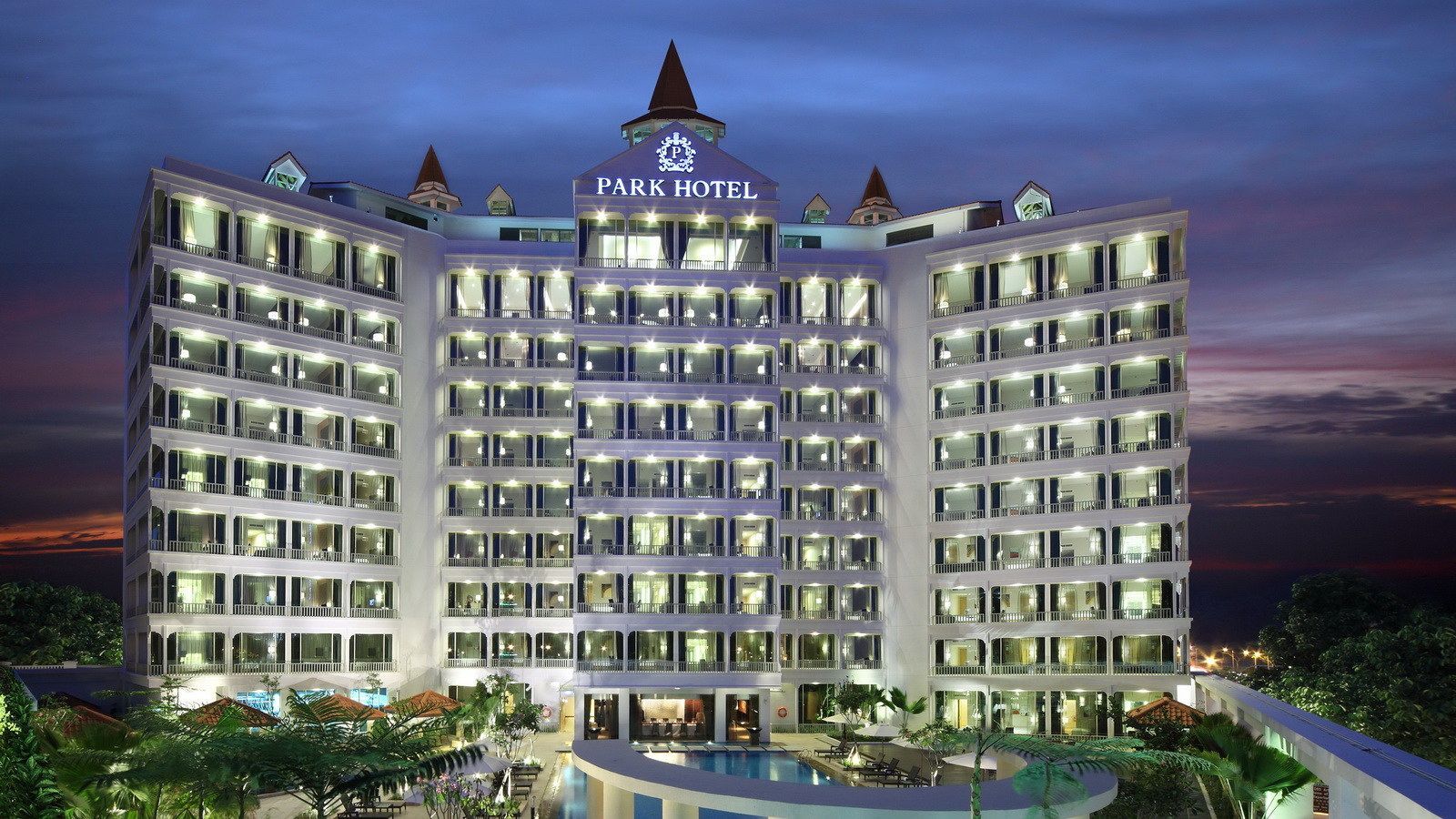
Park Hotel Clarke Quay in Singapore owned by AHT

Brief introduction to AHT

AHT has 10 hotels located in Australia, Japan, Korea and Singapore. In terms of portfolio valuation, Australia makes up 38.7%, Japan at 38%, Singapore at 18.1% and South Korea at 5.3%. In its opening address during the AGM, they mention specifically 3 highlights:
  1. Divested Beijing Hotels for 2.0x valuation
  2. Effective interest rate significantly lower at 2.7%
  3. 3.2% DPS y-0-y improvement
Earlier this year, AHT did divest away their 2 Beijing hotels at much higher valuation. It was the talk of the town as its share price shot up because investors believed that its Net Asset Value is much higher than what they have put in their balance sheet. However, this was short lived when its Australia properties did not do as well and what made it worse was Australia hotels collectively made up the largest contribution to its DPU. Its Australia net property income declined -6.4% in FY2017/18 as compared to FY2016/17.

Its other hotels in Singapore and China did relatively well and Japan 's hotel was unchanged with a slight decrease. Overall, DPU increased 3.2% mainly due to savings in finance cost  and look fee received in connection to the divestment of Beijing hotels.  

One thing to note is that I can see REVPAR is increasing for all its hotels in all countries including Australia. This is an encouraging sign. Its Australia's hotel in Sydney still performed well. One of its Sydney's hotel was also undergoing renovation so this affected DPU in the past 1 year. Moving forward, DPU should continue to be good as the renovation is already done. 

*To understand why REVPAR is important, you can read this article here


Healthy Balance Sheet 

AHT's gearing is at 30.8% which is a decrease from the previous 32.2% after it divested its Beijing hotels. One significant thing to note is that its effective interest rate came down to 2.7% from the previous 3.1%. This is an important factor in this rising interest rate environment which I wrote in another article here. 

Net Asset Value remains stable at $0.92. This means that the current price of AHT at $0.79 is trading at a discount. For its debt profile, 77.2% is on fixed rate while 22.8% is on floating rate. Most of its debt are in AUD and JPY which is not that affected by interest rate movement so far. Japan still has one of the lowest interest rates in the world currently. It might be interesting to note that Japan's key short term interest rate is actually at -0.1% as at June 2018. 


Hotel Acquisition for Growth

After its divestment of its Beijing hotels, AHT continues to pursue growth opportunities by acquiring DPU accretive hotels. It made its maiden entry into Seoul, South Korea by acquiring a hotel that is strategically located in the prominent Dongdaemun area. The acquisition is DPS accretive by 1.7% on pro forma FY2017/18 basis. This is a midscale hotel which was completed in 2015 and it is freehold. 


Separately, it also purchased 3 other hotels in Osaka which is DPS accretive by 4.3% on pro forma FY2017/18 basis. Osaka is a key financial centre both in Japan and globally and also a popular leisure destination. International visitors arrivals in Osaka reached 11.1 million in 2017 and has a CAGR of 43% over the past 5 years. Overnight stays in Osaka also grew by 8% on average, every year for the past 5 years. 

I believe Ascendas Hospitality Trust will continue to grow both in terms of portfolio valuation and also in terms of DPU. A stock price of below $0.80 represents a good 7%+ yield as well as trading below its book value. I will be looking to add more to this investment if it comes down to below $0.75. My last purchase price was at $0.72 and this represents a 8.1% yield which I have been getting for the past 4 years.


Enjoyed my articles? 
or follow me on my Facebook page and get notified about new posts.

Monday, February 19, 2018

Is Comfort Delgro Still A Good Investment? - FY17 Full Year Financial Results and Thoughts

Comfort Delgro recently just released their FY2017  full year financial results. Previously, I did an estimation on how its results will look like in this post. The good news is the results came in better than what I had expected.

Actual results vs what I estimated

In my previous post, I painted a very bleak picture of its business especially its taxi business. I estimated that the revenue of the taxi business will be at $1270.8 Million. Indeed, the taxi business continued to suffer and came in lower than what I had expected at $1208.7 Million.


This was offset by the rise in its public transport business which is the core of Comfort Delgro's business. I estimated the revenue of its public transport business to come in at $2302.2 Million but this came in much higher at $2392.8 Million. This came in higher due to the bus contracting model and also higher revenue for its rail business when DTL-3 started in Oct 2017.

In summary, full year operating profit came in at $409.2 Million, higher than my initial estimate of $379.4 Million. Actual EPS for FY 2017 is 13.95 cents, higher than my estimate of 11.40 cents. With this, the PE ratio is about 14x at current price of $2.05 which is better than what I estimated the PE to be 17.37x at $1.98.

Moving Forward plans of Comfort Delgro

I can sense the management of Comfort Delgro trying as much as they can to get other sources of income and also prevent its taxi business from getting worse. They have formed an alliance with Uber where all Comfort Delgro taxis are under the Uber app now. It is unknown whether this will stop its current taxi drivers from going over to the competitors but seems like it is getting stable as of now. This deal is still pending regulatory approval in Singapore.

Elsewhere in the world, they have made the following merger and acquisition:

  1. Acquired remaining 49% of shares in ComfortDelGro Corporation Australia Pty Ltd
  2. Acquired remaining 49% of shares in CityFleet Networks Limited in United Kingdom
  3. Acquired business assets of Metro Taxi with a fleet of 170 taxis in Perth, Australia
  4. Acquisition of 217 Taxi Licences and Vehicles in Shenyang, China
  5. Acquisition of 100% of shares in New Adventure Travel Group with a fleet of 117 buses and coaches in Wales, United Kingdom
  6. Acquired remaining 51% shares in ComfortDelGro Insurance Brokers in Singapore
Despite all the acquisitions, its financial position is still stable with gearing of 10.6% and cash of $596.2 Million. At current price of $2.05, the valuation is actually quite decent if we expect its business to remain constant. Hopefully, the acquisitions is favourable for the company and they are able to generate more profits from all these. If that happens, then really the stock price of Comfort Delgro will go up. 

If business gets worse, then all these might change and stock price can go south again. I am of the opinion that the worse is over for Comfort Delgro at least in the near term. There is still a lot of monitoring to do for this stock and it is still a high risk one. As of now, I am still vested in this stock and will continue to monitor the developments.  

Enjoyed my articles? 
You can Subscribe to SG Young Investment by Email 
or follow me on my Facebook page and get notified about new posts.

Monday, January 22, 2018

1.55% Interest On The Singapore Savings Bond

I have been monitoring the Singapore Savings bonds for quite some time now since its launch in 2015. The interest was not that attractive to me in the past until now when I notice the first year interest for this month's SSB is at 1.55%. This is higher than most fixed deposits currently and definitely a good place to park extra cash in.

The attractiveness of the SSB

What is so attractive for the SSB is that it is capital guaranteed so there is no risk of losing your capital. There is also the flexibility to redeem the bond every month so we do not have to lock in our money inside for one year like what is required for fixed deposits. This presents a very good opportunity to get higher interest while still maintaining the flexibility for our money.

The below table shows the interest for February 2018 SSB which will be issued on 1st Feb 2018. As we can see, the 1st year interest is already at 1.55% and if we keep our money inside longer, the interest steps up as well.


Details and buying the SSB

Some details of the SSB are as follows:

  • The 1st interest payment will be made on 1 Aug 2018, and subsequently every six months on 1 Feb and 1 Aug every year. 
  • You can invest a minimum of $500, and in multiples of $500 up to $50,000 for this issue. The total amount of Savings Bonds held across all issues cannot be more than $100,000.
  • Application starts from 2 Jan 18 and closes on 26 Jan 18 (9pm)
  • Apply through DBS/POSB, OCBC and UOB ATMs and Internet Banking, OCBC Mobile Application from 7.00am - 9.00pm, Mon - Sat, excluding Public Holidays. On 2 Jan 2018, these channels will be open from 6.00pm to 9.00pm. CPF and SRS funds are not eligible.

How to redeem the SSB?

As mentioned earlier, there is a flexibility of redeeming the SSB every month just in cash you need the money. Similarly to buying the SSB, you can also redeem the SSB through the DBS/POSB, OCBC or UOB ATMs, or online through DBS/POSB’s Internet Banking portal. 

The redemption period opens at 6pm on the 1st business day of each month and closes at 9pm on the 4th last business day of the month. Redemption proceeds will be paid by the end of the 2nd business day of the following month.

Do note that the SSB pays interest every 6 months. If you redeem your bond when there is a scheduled interest payment, you will receive the scheduled interest together with your redemption amount. If you redeem before the scheduled interest is paid, you will receive a pro-rated amount, called the accrued interest, which is the interest you have earned but have not been paid. In essence, even if you redeem the bond early before the interest payment, you will still get pro-rated interest. 


I will be investing some of my money in the SSB for this month as the interest is quite attractive. Nowadays, the stock market valuation has been quite high and I will be looking to re-balance my portfolio to sell some of my stocks which are already overvalued. 


Enjoyed my articles? 
or follow me on my Facebook page and get notified about new posts.

Friday, December 22, 2017

A Sneak Peak Of My Investments And How I Track My Portfolio

Stocks portfolio tracking can be quite a tedious task. I used to key in my transactions into excel individually and it took up quite a lot of my time as I still had to track my dividends and investment returns as well.

However, over the past 1 year, I manage to track my stocks portfolio automatically through a website called stocks cafe. I personally know a few other bloggers and fellow investors using it to track their stocks portfolio as well. It is really easy to use and best of all it sends report on my investment results to me every single day so I got an overview on how my portfolio performed.

This is the kind of update I received in my email every day. I can view it easily on my phone while on my way home after work:

There are also details of each individual stock and how they performed for the day in the email. This allows me to have a summary of what is going on in the market when I have no time to look at my stocks while at work.

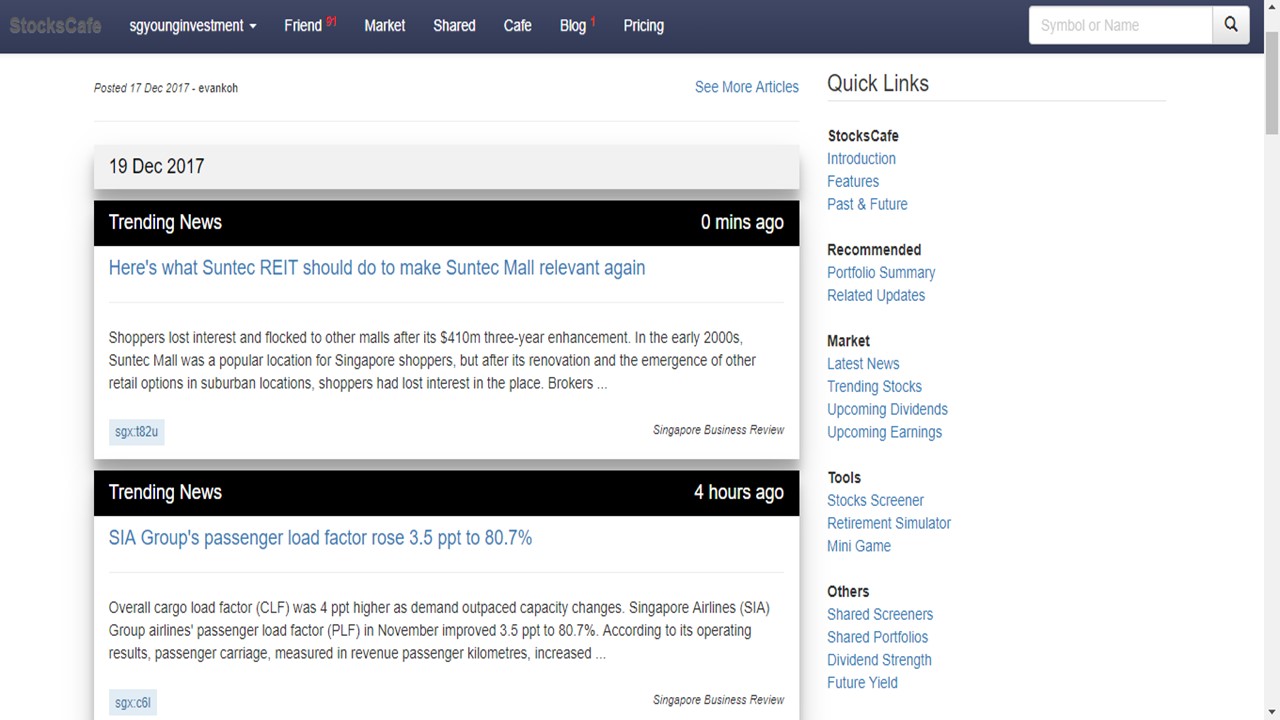
The website of stocks cafe gives many other details including news and basic fundamental of stocks. Every morning, I will go to the website and read the news which are specifically filtered based on the stocks I have in my portfolio. This is how the website looks like:


The first news I see is on Suntec REIT which is a stock I have in my portfolio. There are many other news when you scroll down. When I click on my stocks portfolio, I get the details of each individual stocks I have in my portfolio. I can see the % allocation of the stock in my portfolio, the dividend yield, my average price, the profit and loss and also the dividends I received. This is more than enough to give me an overview of how my stocks are doing and how I can re-balance my portfolio when needed. 


Next, I can see the closed positions and the profit I get from each sell transactions:


I can also see the dividends I received and the dividend yield of my portfolio. There are also details of how much dividends I received from each stock and the projection moving forward. As seen below, I still have one final dividend not yet paid out from Singtel even though it has already XD.


And finally, I can even see my portfolio performance for the current year as well as the past few years. XIRR has been exceptionally good this year at more than 21%.


For research of stocks, the platform also allows me to get basic financial info of the companies and there is always a link to the investor relations page of the individual companies if I'm interested to find more information. Let's take an example of Suntec REIT to view its information on stocks cafe:

Firstly, we can see the stock chart. This is particularly useful for me as I will always at least look at the chart before I buy the stock. I want to try to buy a stock at good support levels.


Next, I can see basic information of the stock including its fundamentals and basic description. Basic financial ratios such as PE, PB, ROA, ROE and also dividend yield can be seen. As mentioned earlier, there is a link to the company's investor relation page under the general section which we can click through to get more information and do deeper research on the company.


Stocks cafe has been useful for me as a portfolio tracking tool and also a platform I am using if I want to find more about a stock. It has served me well for the past 1 year plus. It is free to use but there are some limitations for free users. You can try it first to see if its useful for you. Sign up here using my referral code and get 2 months friends of stock cafe for free.

The holidays are coming as well as the end of 2017. Here's wishing everyone Merry Christmas and happy holidays ahead!


* This is a tool I use personally. This is not a sponsored post


Enjoyed my articles? 
You can Subscribe to SG Young Investment by Email 
or follow me on my Facebook page and get notified about new posts.

Wednesday, December 20, 2017

A Letter To My 20 Year Old Self 10 Years Later

Soon, I'll be turning 30 in 2018. I'm growing older each day with this blog even though its still called SG Young Investment. This blog will always stay young and continue to inspire the next generation of young people even as I grow older.

There are many decisions which I have made in the past 10 years, some good while some not so good. This is a letter which I would write to my 20 plus year old self which shows my life journey and also what I've learnt so far. Hopefully through this letter, you would be able to learn from some of the decisions I made and if you're in your early 20s or younger, this letter will hopefully let you make wiser decisions and motivate you in your life.


Dear 20 year old,

Life is always a roller coaster. It is also an unknown what will happen 10 years later. But one thing for sure is the decisions we make in life will somehow determine our future. However, fate still determines some key milestones in our life.

At the age of 20, you will go through a major milestone in every Singaporean boy's life, that is serving national service. The experience will show you that life can be pushed to the limits even when we think we can't do it. If we persevere on, we will see results. The spirit of never give up is born in the army.

It is also during this time when you will start to get serious about your life. What shall I do in my life is the question? There were actually few choices left since your polytechnic results were not that fantastic to get into a university. You also did not know what to really further your studies on. The decision was made to just work in the same field which you studied for your diploma. Through scrimping and saving, you managed to save your first 5 figure savings of only $10,000 at the age of 21.

Money was the focus after you came out of army. Receiving just a salary of $1700 was the largest amount you have ever earned a month since you were born. Yes you had worked several part time jobs in the past but this was the first full time job. Not knowing what to expect is always on your mind before the first day of work. Through working, your savings manage to increase and because of the frugal lifestyle, you could even save $20,000 a year.

Stepping into the working world wasn't a bad experience. The colleagues were nice, the boss was nice and the working culture was good too. You were the youngest in the company and people took care of you and often giving you advise of life. Some were about your father's age and listening to them gave you some perspective of life from different people, their regrets and their achievements which they were proud of. You listened attentively day in and out and got some really good lessons from some of these older and wiser people.

Many people regretted staying too long in the company and always advised you to further your studies and advance in your career. After much consideration and deliberation, you decided to take up a degree course of economics which was completely different from the engineering which you studied before and what you are working as. It was a very tough choice coupled with having to balance both work and studies at the same time. The few years, no doubt were tough, but also the most fulfilling time of your life. Even as you studied part time and worked full time, this blog was born because you found the passion for financial stuff. You met more like minded people, made new friends, did stuff which you never thought you could do such as public speaking, attending conferences and events and talking to successful people at the top. You graduated with the degree eventually and never regretted the decision you made.

Even though you reminded yourself not to stay in the company for too long, you still did. After graduation, you continued staying in the company for another 2 years. Was it a wrong decision? It is really very hard to tell. Getting out of the company earlier will allow you to advance your career faster but you may not have met some people or have done some stuff if you had left earlier. But really who knows what really would have happened if you had made a different decision.

Still, staying in the same company after graduation seemed to allow you more time to focus on life beyond work. You met your girlfriend during this time and life changed after that. Fortunately or unfortunately, as a guy in the relationship, your expenses increased. This motivated you to think about increasing your income instead of just trying to save money. I could spend lesser alone but I don't want to save on my partner. So, the journey to embark on increasing income started from then on. Fortunately, opportunities presented itself even when you did not really look for it. The goals were mainly focused on savings beforehand but it changed to creating income thereafter and things just worked out accordingly somehow.

On investing, you tried all sorts of style and attended lessons outside but mostly did not work out at the start. Investing only worked when you found the style that suits you and never think of making money. Its a psychological game of greed and fear afterall. Once these 2 are removed, investing is much more easier.

Through this life, you learnt that people matter in your life. It is the people around you which make life interesting or sad. So, it is important to surround yourself with the right people in your life. The right people will motivate you while the wrong people will drag you down. The rest of the plans such as setting goals are but a road map on the destination which you want to reach. In the end, its the journey that matters. Just like planning for a holiday, we do not focus on reaching the destination only but enjoying the journey to the destination as well. The time spent with the people along this journey, the experience experienced goes a long way in our memories. Therefore, enjoy the journey while reaching your goals.

Are there any regrets in life? Most probably yes but I think everything happens for a reason. Instead of regretting, focus on the future and get back on the path which you set out initially. Sometimes, we may have gone off course but there is always time to get back on track. To my 20 year old self, there is still a long road ahead. Life will be good as long as we believe it. Never give up on your goals.

Yours truly,
From the 10 years later you


Enjoyed my articles? 
You can Subscribe to SG Young Investment by Email 
or follow me on my Facebook page and get notified about new posts.

Monday, December 4, 2017

Summary of My Investment For 2017

How time flies, its near the end of 2017 already. We are now in the month of December which is just less than one month away from the Christmas and new year celebrations again. In this post, I will do a summary of my investments and what has happened in 2017. Nearer to the end of the year or early start of next year, I'll write another post on the investment strategies for 2018.

For 2017, it has been an extraordinary year for investments. You may ask how extraordinary is it? Using the Straits Times Index as a benchmark, if we have invested at the start of the year and did nothing, it would have gained about 18% return on investment by now.


The STI ETF started at 2.95 at the beginning of the year. It is now at 3.48. I did invest some of my money into the STI ETF back when it was $2.80 last year. To date, it has gained over 30% inclusive of dividends.

For this year, I only had 14 buy and sell transactions. Most of the stocks were bought near the end of last year where I thought valuations were attractive back then. Some of my stocks were acquired, especially the Japanese Reits, which had been a good income investment (7%-9% dividends) and also capital gain (more than 80%). For 2017, I invested more into the hospitality sector namely Far East Htrust. I also subscribed to the rights of CDL Htrust. Both investments have been good especially CDL HTrust which has seen its value went up close to 30%. I also invested into Comfort Delgro seeing the distress in the taxi industry. It has yet to be proven whether this investment will work out so there's still much monitoring to do.

There was another rights issue by Capital Commercial Trust (CCT) which I also subscribed to it. I manage to get quite a lot of excess rights which was a bonus. The investment in CCT has gained over 50% (inclusive of dividends) to date. Office Reits are performing quite well currently where there are expectations that office rents and occupancy will continue to do well. Another investment I have in office Reits is Suntec Reit which also provides stable dividend income for me.

All in all, the average dividend yield of my investment portfolio is about 5.14% and the XIRR this year is around 21.17%. My portfolio value is slightly above $60K now. The next plan will be to increase my investments to $100K whenever opportunities to invest comes my way. There remains a few weeks left to the end of 2017. I may still have some other transactions in December and also there is one more dividend from Singtel where there will be a special dividend paid out.

We shall see how the market performs for the rest of the year. Elsewhere on the news, Bitcoin has been really hot these days where I see people everywhere talking about it. This is a sign of a bubble which we do not want to see. I'm not into this investment and will stay away from it as far as I know. It is never a good thing to have greed in investments.

Enjoyed my articles? 
You can Subscribe to SG Young Investment by Email 
or follow me on my Facebook page and get notified about new posts.

Thursday, August 10, 2017

Far East Hospitality Trust 2Q 2017 Financial Results - Review & Action

Far East Hospitality Trust just released their financial results last Friday and I thought it would be good to do a quick update since I've been writing a lot on the hospitality industry as an investment opportunity.

Net property income still decreased by -6% in 2Q 2017 as compared to 2Q 2016. However, this is a smaller decrease compared to the 1Q decrease of -10.4%. Average hotel occupancy was 87.1% in 2Q as compared to 88.1% in 1Q. Comparing year on year, occupancy increased 1.9%. RevPAR remains stable at $134 which is a good sign that it has bottomed out. Comparing year on year, RevPAR decreased -4.6% in 1Q while it decreased -1.3% in 2Q. This is a smaller decrease which is again a good sign that RevPAR is bottoming.

Credit: http://www.fareasthospitalitytrust.com/rendezvous-hotel-singapore.html

In summary, hotel occupancy has increased by 1% for the 1H of 2017 while serviced residence has decreased by -8.7%. RevPAR still remains low but shows signs of bottoming out. Far East Htrust portfolio consists of 64.8% hotels, 12.9% serviced residences and 22.3% commercial which contributes to its gross revenue. From the time I invested in this stock, the stock price has gone up by 10% and I've divested a portion of my investment in this stock at 0.67. It is still trading at a PB of 0.74 which represents a discount to NAV of 26%. The dividend yield at current price is about 6.24%. The reason for divesting it is to lock in some gains first while monitoring it for any other upside.

I also did a check on one of its competitors, Frasers Hospitality Trust and looked at its Singapore properties portfolio. I noticed that Frasers Htrust Singapore properties registered a higher RevPAR for both its properties. It is an impressive gain of 4.1% Y-Y.  For all its other countries portfolio, the gross operating profit also increased. Frasers Htrust will be the next investment opportunity I'll be looking at. However, it's trading at a PB of 0.99 and dividend yield of 6.53%. It seems to be at a fair price currently so if we want to invest now, there may be limited upside. I shall monitor and keep it in my watchlist for any good entry points.

Enjoyed my articles? 
or follow me on my Facebook page and get notified about new posts.